

Every year, families and collectors lose thousands of dollars in damaged belongings during a move, and it almost always comes down to the same mistake: packing something irreplaceable in a box designed for books and kitchenware.
A standard corrugated moving box handles compression reasonably well, but it offers almost zero protection against impact, vibration, or climate shifts. For most household items, that's fine. For the 11 items on this list, it's a gamble you cannot afford to take.
Here's what actually needs custom protection, and why.
Why Standard Moving Boxes Fail High-Value Items
Before we get to the list, it helps to understand what a standard moving box actually is and what it isn't.
A typical double-wall corrugated box has a burst strength of around 275 PSI. That sounds impressive until you realize that a single hard bump during transit can generate localized pressure well beyond that threshold on a rigid, fragile object like a marble sculpture or framed oil painting.
Standard boxes also lack three things that irreplaceable items require: rigid immobilization (preventing any internal movement), climate buffering (protecting against temperature and humidity swings during transit), and impact distribution (spreading force across a larger area instead of concentrating it on the object).
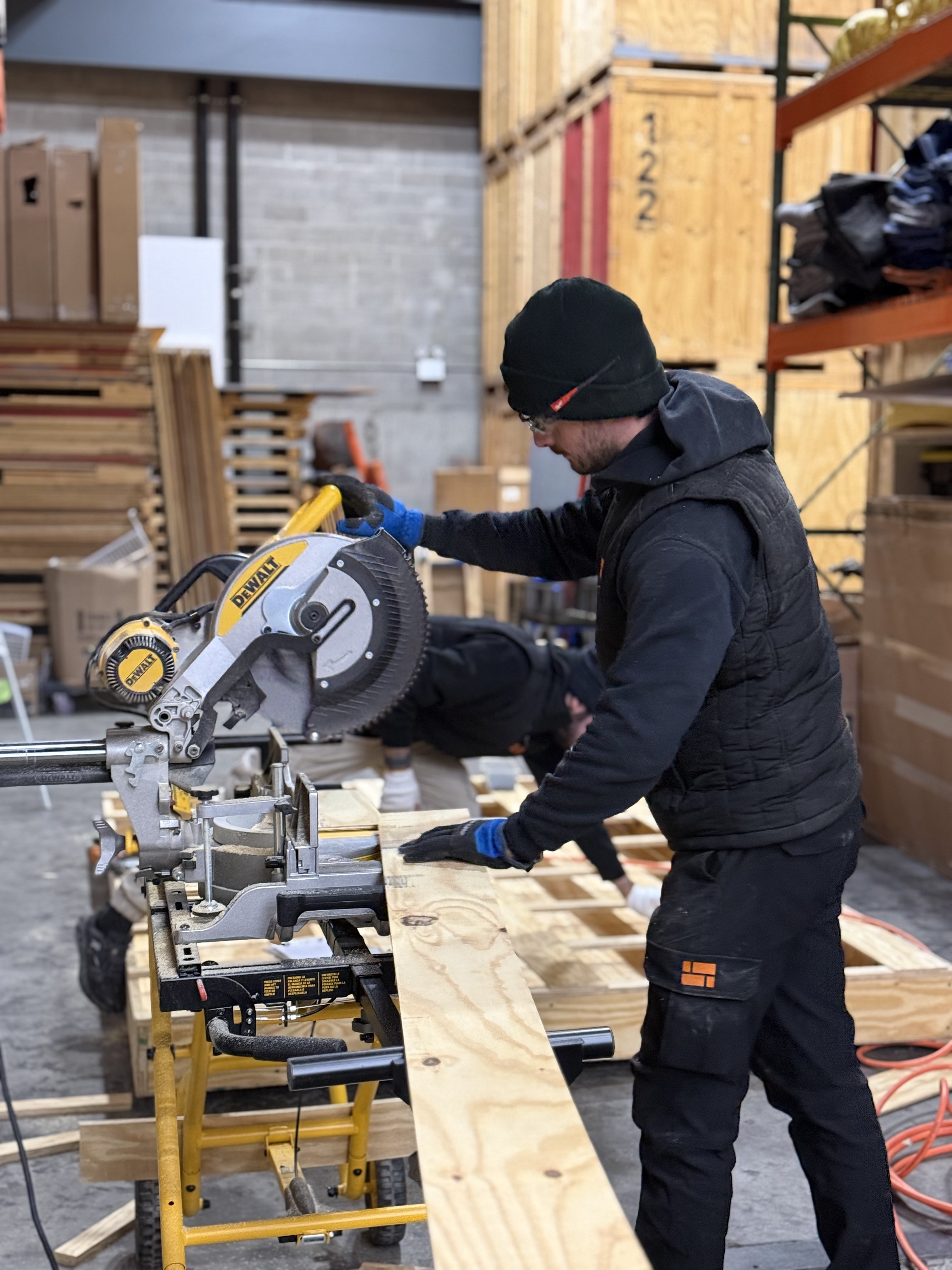
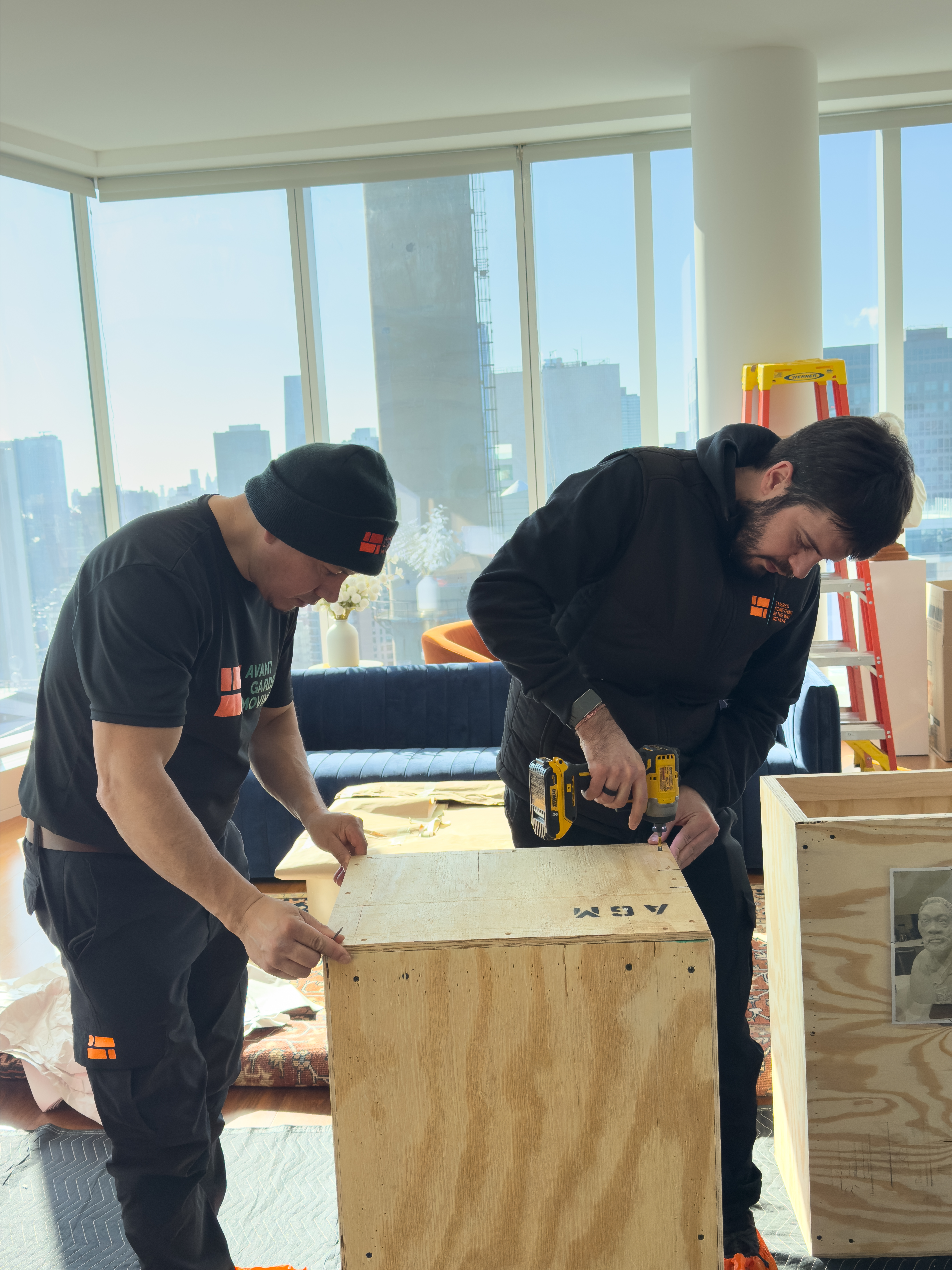
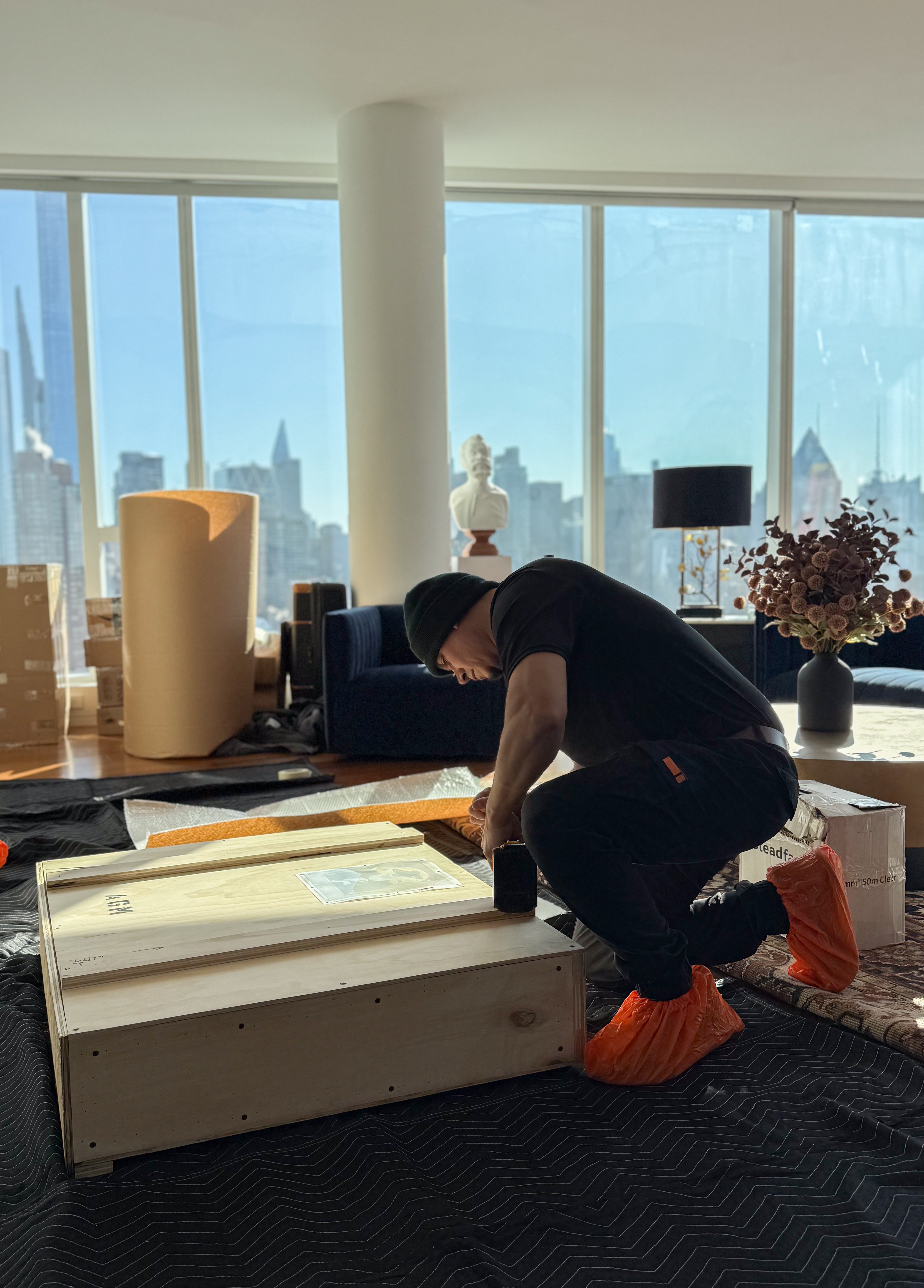
Custom crating solves all three. A museum-quality crate uses plywood construction, internal bracing, foam cavities custom-cut to the object's exact dimensions, and vapor barriers when climate protection matters.
The 11 Items That Demand Custom Protection
1. Original Oil and Acrylic Paintings
Oil paintings are uniquely vulnerable because the paint surface remains semi-flexible for decades after drying. A standard box pressing against the canvas can cause cracking, flaking, or permanent impressions in the paint layer.
What proper packing looks like: Acid-free glassine paper over the surface, corner protectors on the frame, and a custom-fit crate with internal cleats that hold the frame without touching the painted surface. For high-value works, a floating mount inside the crate absorbs shock without transferring it to the painting.
Fine art moving tip: Never wrap an oil painting in bubble wrap directly against the surface. The texture of the wrap can imprint into soft paint, especially in warm conditions.
2. Framed Works Under Glass
The combination of glass, a rigid frame, and a delicate interior (watercolor, photograph, or print) creates a triple threat. Glass shatters. Frames crack at the corners. And if either fails, the artwork behind them is destroyed.
What proper packing looks like: Painter's tape in an X pattern across the glass (to contain shards if it breaks), padded frame corners, and a telescoping or custom-fit crate that prevents any lateral movement.
3. Large-Scale Sculptures and 3D Art
Sculptures present packing challenges that flat art doesn't: irregular shapes, protruding elements, extreme weight distribution, and materials that range from bronze to unfired clay.
A standard box cannot immobilize a three-dimensional object with asymmetric weight. The sculpture shifts during transit, and whatever protrudes first absorbs the impact.
What proper packing looks like: A crate built around the specific sculpture, with custom-carved foam that cradles every contour. For stone or ceramic pieces, internal bracing prevents any movement in any direction, including vertical.
4. Antique and Vintage Mirrors
Antique mirrors fail in transit for a reason most people don't expect: it's usually the frame, not the glass. Ornate gilded frames from the 18th and 19th centuries are held together with animal-hide glue that has become brittle with age. Vibration alone can cause joints to separate and decorative elements to detach.
What proper packing looks like: The mirror is crated vertically (never flat), with custom foam supports along the frame and a rigid internal structure that eliminates vibration transfer.
5. Grandfather Clocks and Antique Timepieces
A grandfather clock is essentially a tall, top-heavy wooden cabinet containing a precision mechanical instrument. The pendulum, weights, and movement must be removed and packed separately. The case itself needs to be immobilized vertically in a crate designed to prevent any racking (side-to-side twisting).
What proper packing looks like: Weights wrapped individually in padded bags. Pendulum secured in a separate padded container. The case crated upright with internal bracing at the waist and hood to prevent flexing.
6. Marble and Stone Tabletops
Marble is both extremely heavy and surprisingly brittle. A 1-inch-thick marble slab can snap cleanly from a single impact point, and standard box construction cannot distribute the concentrated weight across its floor without risk of failure.
What proper packing looks like: The slab is separated from its base, stood on edge (never laid flat in a box), padded on all faces, and crated in a structure rated for the specific weight with internal edge supports.
7. Antique Ceramics, Porcelain, and Pottery
The difference between a $50 vase and a $5,000 Meissen figurine isn't just price. It's the fact that antique ceramics often have invisible hairline fractures, previous repairs, or structural weaknesses that standard packing cannot account for.
What proper packing looks like: Each piece individually wrapped in acid-free tissue, then cushioned in custom-cut foam within a double-walled crate. For groupings of ceramics, each piece gets its own cavity so nothing touches anything else.
8. Musical Instruments (Grand Pianos, Harps, Cellos)
A grand piano contains over 200 strings under roughly 20 tons of combined tension. The soundboard is a thin sheet of spruce designed to resonate, not to absorb impact. Moving one in a standard box (or even a standard piano board) without proper crating risks cracking the soundboard, warping the pin block, or damaging the action mechanism.
What proper packing looks like: Custom-padded piano board with internal locking straps, climate-controlled transport for long distances, and a crew trained specifically in piano moving.
9. Wine Collections (Aged or Investment-Grade)
Wine is one of the few items on this list where climate is the primary threat rather than impact. A temperature swing of even 10 degrees during a summer move can push corks, oxidize wine, and destroy bottles worth hundreds or thousands each.
What proper packing looks like: Styrofoam wine shippers rated for temperature stability, packed in insulated crates with gel packs for climate control. For collections over 50 bottles, refrigerated transport is worth the cost.
10. Chandeliers and Light Fixtures with Crystal or Glass
Chandeliers combine every difficult packing variable at once: extreme fragility, irregular shape, dozens of individual components, and materials (crystal, glass, gilded metal) that scratch and crack on contact with each other.
What proper packing looks like: Every crystal pendant and arm removed individually, wrapped in acid-free tissue, and placed in a compartmentalized tray. The frame is padded and crated separately. Reassembly instructions and a photo map are essential.
11. Heirloom Textiles, Tapestries, and Rugs
A 200-year-old tapestry or hand-knotted Persian rug can be destroyed by folding. The fibers at fold points crack, colors separate, and structural threads break. Standard boxes force these items into folds that cause permanent damage.
What proper packing looks like: Rolled (never folded) around an acid-free tube, wrapped in muslin or Tyvek, and placed in a cylindrical crate or an oversized flat crate. Mothballs and cedar are avoided, as the chemicals can discolor antique fibers.
Standard Box vs. Custom Crate: What's Actually Different?
This comparison helps illustrate why the cost of custom crating is justified for irreplaceable items.
| Feature | Standard Moving Box | Museum-Quality Custom Crate |
|---|---|---|
| Wall material | Corrugated cardboard (double-wall) | 3/8" to 3/4" plywood |
| Impact resistance | Low to moderate | High (military spec available) |
| Internal cushioning | Packing peanuts, newspaper, bubble wrap | Custom-cut polyethylene or polyurethane foam |
| Object immobilization | Minimal (item can shift) | Total (foam cavity matches exact shape) |
| Climate protection | None | Vapor barrier lining, optional desiccant packs |
| Weight capacity | 65 lbs (typical large box) | Engineered to the specific load |
| Reusability | Limited | High (can be stored and reused for future moves) |
| Cost | $3-8 per box | $150-2,000+ depending on size and complexity |
The cost gap is real, but so is the risk calculation. For an item worth $500 or more, or for anything that simply cannot be replaced, the crate pays for itself the moment the truck hits its first pothole.
How to Decide: DIY Packing or Professional Crating?
Not everything on this list requires you to hire a specialist. Here's a practical framework:
You can likely DIY with proper materials if the item is under 20 lbs, has a simple geometric shape, and is worth under $500. Framed prints, small ceramics, and standard wine bottles fall here. Invest in proper materials (acid-free tissue, custom-cut foam inserts, double-boxing) and take your time.
Hire a professional crating service if the item is over 20 lbs, has an irregular shape, is worth over $500, or is truly one-of-a-kind. Original art, antique furniture, musical instruments, and collections of any significant value belong in this category. In New York City, custom crating services typically range from $200 to $2,500 per item depending on size and complexity.
Questions to ask any crating provider:
- Do you build custom cavities or use generic foam inserts?
- What plywood grade and thickness do you use?
- Can you provide climate-controlled storage if there's a gap between pickup and delivery?
- Are your handlers trained in fine art or specialty item handling?
- What does your insurance cover, and what are the claim limits?
FAQ
How much does custom crating cost in NYC?
Custom crating in New York City typically ranges from $150 for small, simple items (like a single framed work) to $2,500+ for large or complex pieces like grand pianos, oversized sculptures, or full chandelier disassembly and crating. Most single paintings or mirrors fall in the $200-$600 range. Always request an in-home assessment for accurate pricing.
Can I use bubble wrap instead of custom crating for paintings?
Bubble wrap alone is not sufficient for original paintings. It doesn't prevent surface contact pressure, and the textured surface can imprint on soft paint in warm conditions. For prints or reproductions, bubble wrap with corner protectors and a rigid outer box is acceptable. For originals, custom crating with a floating mount is the standard.
What's the difference between a moving company and a fine art mover?
Standard movers are trained to handle household goods efficiently. Fine art movers and custom crating specialists are trained to handle objects where damage is either irreversible or catastrophic to the item's value. The difference shows in materials (museum-grade vs. commercial), handling protocols (white-glove procedures, climate-controlled vehicles), and insurance coverage (specialized fine art policies vs. standard moving liability).
How do I pack fragile items for moving if I'm doing it myself?
Start with the right materials: acid-free tissue paper, polyethylene foam sheets, custom-cut foam inserts, and double-walled boxes. Wrap each item individually, ensure nothing touches anything else inside the box, fill every gap so nothing shifts, and label clearly with "FRAGILE" and orientation arrows. For anything you cannot replace, consider whether the cost of a mistake outweighs the cost of professional crating.
Should fragile items be moved in the car instead of the moving truck?
For small, high-value items like jewelry, small antiques, or important documents, yes. Your personal vehicle gives you control over temperature, vibration, and handling. For larger fragile items that won't fit in a car, professional crating and specialty transport are the safest options.
If you're planning a move in the New York area and have items that need more than a standard box, get a free quote or call us at (929) 282-4882. Our team handles everything from custom crating to white-glove delivery for fine art, antiques, and irreplaceable belongings.