
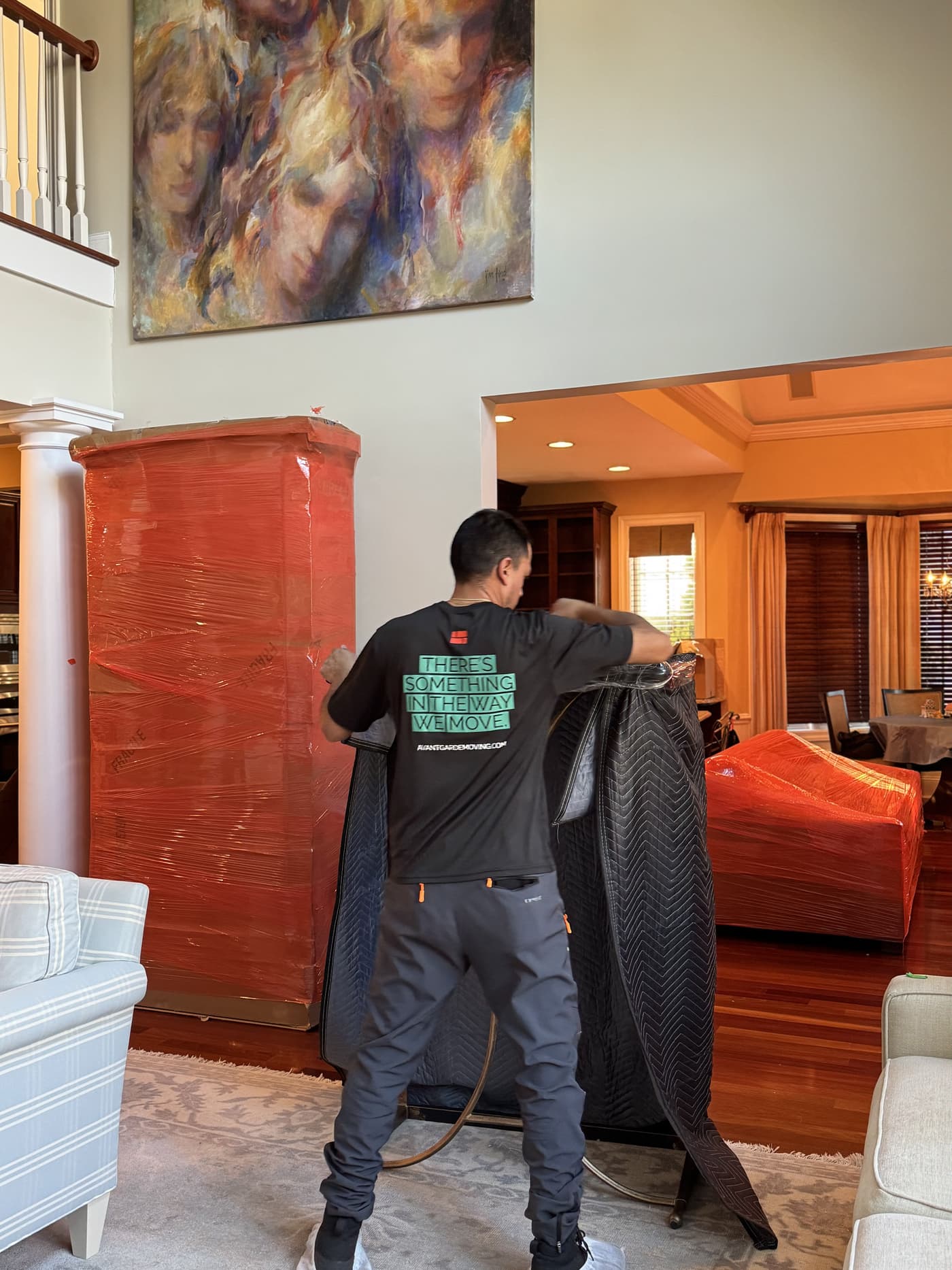

Antique furniture is the category that most often gets damaged in an NYC move, and not by accident. It is damaged because the same crew that wraps a contemporary sofa in shrink film does the same thing to a Victorian settee, and an upholstery tack pops, or an inlay lifts, or a finish bonds to the plastic. Modern furniture forgives sloppy handling. Antiques do not.
This guide walks through what actually matters when moving antique furniture through New York City: how to assess pieces honestly, where the real damage risks live, how to wrap and crate properly, and how to make sure the insurance picture matches the value of what is on the truck.
Why Antiques Are a Different Move
The difference between modern and antique furniture is not just age. It is construction.
A modern dresser is engineered for a single home and an occasional move. It is built with particle board, hidden fasteners, and tolerances designed for flat-pack assembly. It will survive a wrap-and-load process because the design assumes it.
An antique highboy from 1880 is a different object. It is solid wood, often with hand-cut dovetail joinery, hide glue holding the joints, veneer or marquetry that is essentially a thin skin laminated to a substrate, and hardware that may not be original. It was built for a room, not for transit. The glue is brittle. The veneer is sensitive to humidity. The hardware is often the most valuable part of the piece and the easiest to lose.
A standard moving crew approaches antique furniture the way they approach modern furniture, and that is where the damage starts. A serious mover treats antiques as a separate category, with separate technique, separate materials, and a separate timeline.
Our antique furniture movers service page describes the team we send for this work. The difference is not branding. It is the difference between a crew that has wrapped a thousand sofas and a crew that has wrapped a hundred period pieces and knows what each one needs.
Honest Assessment Before the Move
Every antique move should begin with a piece-by-piece walkthrough. The owner and the lead handler look at each item together and answer four questions:
-
Is this stable enough to move as-is, or does it need conservation first? A piece with a loose veneer panel or a cracked stretcher should be stabilized by a conservator before any move. A mover cannot fix a structural issue and should not paper over it with extra padding.
-
How does it disassemble? Some pieces (a large breakfront, a tester bed, a partner's desk) must come apart to leave the room. The question is whether disassembly is possible without harming the joinery.
-
What is the finish? Shellac, French polish, lacquer, milk paint, and oil finishes all react differently to wrapping materials and to environmental change. The wrap chosen for an oiled walnut sideboard is not the wrap chosen for a shellacked Federal-era chest.
-
What is the hardware story? Brass pulls, hand-forged hinges, ivory escutcheons, original keys. Anything detachable should be inventoried, photographed, removed if appropriate, and bagged with a label that ties it back to the piece.
A serious walkthrough takes time. For a collector with twenty antique pieces, expect two to three hours on site. That time prevents the conversation at the unload that begins with "Wait, where is the missing escutcheon."
Disassembly: When and How
The rule with antique disassembly is: as little as possible, but as much as necessary.
A large dining table that does not fit through a Manhattan apartment door has to come apart. A 19th-century wardrobe with a removable cornice and shelves should be partially disassembled to reduce weight and protect joinery during the lift. A simple chest with hand-cut dovetails should never be disassembled because the joinery is the structure.
When disassembly happens, three principles apply:
- Document everything. Photograph each step. Bag and label every screw, peg, dowel, and bracket. A piece that arrives in the right room with a missing dowel is a piece that cannot be reassembled without a trip to a conservator.
- Respect the original hardware. If a screw is hand-cut and threaded irregularly, it does not get replaced with a modern equivalent. It goes in a labeled bag and comes back to the same hole.
- Use the right tools. A modern Phillips driver in an antique slotted screw will tear the head and leave a mark that is permanent.
For irreplaceable pieces, the safer answer is often to engage a conservator or a specialist restorer to handle the disassembly and reassembly, with the mover responsible for transit only. This split is common and often less expensive than the alternative if anything goes wrong.
Wrapping: The Single Biggest Source of Damage
Wrapping is where the most damage happens, and it almost always happens for the same reason: the wrong material against the wrong finish.
A few rules that prevent the most common mistakes:
- Never put plastic shrink film directly on an antique finish. On a warm day, shrink film can bond to a shellac or French polish surface and lift it when removed. The first layer against the wood should be soft, breathable, and acid-free: cotton blankets, glassine paper, or unprinted newsprint.
- Use moving blankets as the second layer, secured with cotton straps or rope ties, never with tape pressed against the finish.
- Pad every contact point. Where a strap crosses a leg, foam padding goes between the strap and the wood. Where a blanket touches a brass pull, a soft pad goes underneath.
- Wrap upholstery separately. Antique upholstery, especially silk or horsehair, should be protected with breathable cloth, never plastic, to prevent humidity buildup and surface marks.
- Tag every wrap. A wrapped piece is unrecognizable. A tag with a unique inventory ID, an arrow pointing to the top, and a fragile warning should be attached to every wrapped item.
Our post on items you should never pack in standard moving boxes covers a related principle: some objects need their own packaging, and antique furniture is the largest such category in any home.
Crating: When a Wrap Is Not Enough
Wrapping protects against contact and surface contamination. Crating protects against impact, vibration, and humidity change. For some antique pieces, wrapping alone is not enough.
Candidates for custom crating include:
- Marble-topped commodes (the marble travels in its own crate, separately from the base)
- Pieces with extensive marquetry or inlay
- Mirrored sections of large furniture
- Glass-fronted display cabinets where the glass is original
- Anything traveling more than a short local distance, especially with a long highway leg
- Anything going into storage, even temporarily
A custom crate for antique furniture is usually a plywood shell with rigid foam interior, sized to the piece plus protective space, often with internal blocking that takes pressure off any unstable joinery. Our custom crating service handles these builds and we typically construct them in advance, with the piece crated at the residence.
The cost of a crate is meaningful but small relative to the value of what it protects. For a $40,000 antique cabinet, a $700 crate is the kind of math that does not require a spreadsheet.
Climate and Timing
Antique furniture, like fine art, reacts to humidity. Wood expands and contracts. Veneers, which are essentially thin laminates, are especially sensitive because the substrate and the veneer often respond at different rates.
The practical implications for an NYC move:
- Peak summer humidity is the worst window for major antique moves. Veneer panels that have been stable for decades in a controlled apartment can lift when the humidity swings 30 percent during loading.
- Climate-controlled trucks matter for any meaningful collection. The premium over a standard truck is small relative to the consequences.
- Acclimation matters at the destination. A piece moved from a 50 percent humidity apartment in Brooklyn to a 30 percent humidity loft in Manhattan should not be moved against an HVAC vent. Place it away from direct airflow for a few weeks while it acclimates.
For longer holds between residences, climate-controlled storage is the only correct answer. Our fine art storage service is designed for the same conditions antique furniture requires, and the two categories often store together.
NYC Building Constraints
A real-world antique move in NYC lives or dies on building access. The pieces that fit through a 19th-century Brooklyn brownstone door may not fit through a contemporary Manhattan high-rise door, and vice versa.
Common access issues:
- Service elevators with diagonal limits. A piece can be measured against the door opening and still not fit because the elevator interior is shorter than the longest piece needs to be carried.
- Stairwell turns. A grand piano-style turn in a pre-war stairwell can prevent any rigid piece longer than the stairwell width from passing.
- Doorway frames. Particularly tall pieces (highboys, secretary desks) often cannot pass through standard interior doors without disassembly.
- Co-op move rules. Many co-ops require Certificates of Insurance, weekday-only moves, building-supplied padding for elevator walls, and specific time windows. These rules are not negotiable and should be confirmed days in advance.
We cover the broader NYC building-access picture in our brooklyn-to-manhattan move guide, and the same logic applies for any antique move across the five boroughs.
A good mover does a measurement walkthrough before the move date for any piece that is even close to a limit. The worst place to discover a piece does not fit is in the hallway, with the elevator timer running and the building staff watching.
Loading, Transit, and Securing
On the truck, antique furniture should be:
- Loaded in an upright orientation whenever possible
- Strapped to E-track or interior rails, never bungee-corded
- Placed with at least four inches of pad between any two pieces
- Loaded so that lighter pieces are not stacked on softer wood, and heavier pieces are placed low and forward
Drivers handling antique loads tend to drive differently than drivers handling standard residential loads. Slower braking, earlier lane changes, avoiding hard potholes. This sounds obvious until a crew that has done it ten times moves cargo that one driver has handled for twenty years. The latter shows up in the condition of what comes off the truck.
For longer transits, an overnight hold in a climate-controlled facility is preferable to a long highway day for sensitive pieces. We coordinate this regularly for clients moving valuable collections out of state.
Insurance: What Actually Protects Antiques
The same warning that applies to fine art applies to antique furniture: standard moving company "valuation coverage" is not insurance.
The default federal released-value coverage pays 60 cents per pound for damage. A 200-pound antique secretary worth $25,000 would, under released-value, pay out $120. This is not a clerical error. It is the legal default if no other coverage is purchased.
For antique pieces, three layers of protection should be in place:
- Declared value with the mover, in writing, before the move. Any piece above a stated threshold should be identified, valued, and added to the move documentation.
- A homeowner's or renter's rider covering the pieces during transit. Most standard policies do not automatically cover items in transit and do not cover items in temporary storage. Confirm this with the insurer before move day.
- Standalone fine art and antiques insurance for serious collections. These policies are written by specialist insurers and cover transit, storage, and on-premises risks with realistic per-item limits.
Our post on moving insurance in NYC walks through the difference between valuation and insurance in plain language. Read it before any move involving heirloom or high-value pieces.
A practical step: take photographs of every antique piece in good light, with a ruler for scale, in the weeks before the move. Store the photos in cloud storage, not just on a phone. If a claim is ever needed, the photo set is the foundation of it.
Budgeting Honestly
Antique moves cost more than standard moves. The reasons are real: more handlers per piece, more time per item, better wrapping materials, possibly custom crating, climate-controlled trucks, and longer walkthroughs. The premium is typically 30 to 80 percent over a standard residential rate for the same apartment, depending on how much of the contents qualifies as antique.
For a one-bedroom with five to ten meaningful antique pieces and the rest standard furniture, expect a meaningful but manageable add-on. For a serious collection, such as a townhouse with a hundred antique pieces, the cost reflects the complexity, and it should.
The math that matters is not the move price. It is the move price plus the expected damage cost. Done correctly, a careful antique move costs more upfront and zero in damages. Done carelessly, a cheap move can cost a five-figure conservator bill, or the permanent loss of a piece that cannot be replaced.
Choosing the Right Mover
Questions worth asking any company quoting an antique furniture move:
- How many handlers will be assigned and what is their specific antique experience
- What wrapping materials will go directly against the finishes
- Will the truck be climate-controlled
- Do you provide a written inventory and condition report
- What is your valuation coverage and per-item liability limit
- Have you worked with conservators for disassembly and reassembly
- Can you provide references from clients with comparable collections
The answers reveal whether the company treats antiques as a routine residential category with extra padding, or as a specialty category with its own discipline. The first will sometimes succeed. The second has built its process around the things that go wrong, and that is the only way the work stays invisible to the furniture.
A properly moved antique looks exactly the same in its new room as it did in the old one. That outcome is the entire goal, and it is the result of decisions made long before the truck arrives.