
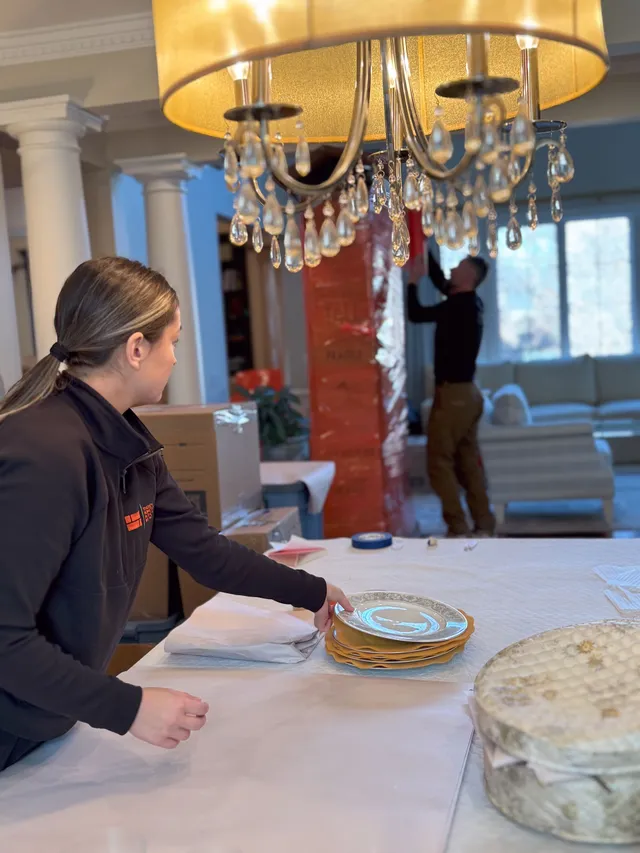

Moving a mattress through a NYC walk-up looks simple until you actually try it. About a third of the mattress moves we get called in to rescue start the same way: a king folded in half, jammed down a stairwell, and creased at an angle it was never designed to bend at. By the time we arrive, the warranty is often already void and the foam permanently damaged. Here's how to avoid that sequence and move a mattress without destroying it, your back, or your security deposit.
The "Fold It in Half" Myth Needs to Die
The single most expensive mistake people make moving a mattress in NYC is folding it. Not curling. Not bowing. Folding, bending it past 90 degrees so two halves face each other.
If your mattress is a basic spring innerspring from the '90s, you can probably get away with a gentle bow for a few minutes. If it is anything made in the last fifteen years, folding it will damage it. Memory foam develops permanent compression creases where the foam cells crush against themselves. Hybrids, the foam-over-coil constructions that dominate the market now, bend in two places at once, and the transition layer between foam and coil delaminates. Innersprings bend the actual coils, which then push back against the padding at uneven angles forever.
Most major mattress manufacturers void the warranty the moment a mattress is folded for transport. Tuft & Needle, Casper, Saatva, Tempur-Pedic, Purple, read the fine print. They all have language about "improper handling" and folding is the example they cite.
The shipping cartons your boxed mattress arrived in are a special exception: those mattresses are compressed and rolled in a controlled factory environment, vacuum-sealed before they expand. Once expanded, that window is closed. You cannot put it back in the box.
Mattress Types and What Each Can Actually Survive
Different mattresses have wildly different tolerance for being abused on a staircase. Knowing which kind you own changes everything about how you should handle the move.
Innerspring (traditional coil) is the most forgiving. A flexible bow during a tight turn won't usually destroy it. The risk is bending the coils permanently if you actually fold. A standard queen innerspring can be tipped vertical, bowed slightly through a doorway, and survive without complaint.
Memory foam is gummy, flexible, and warranty-sensitive. It can flex more than people expect, but only briefly. Most memory foam shouldn't be folded for more than two hours, and even then only with a gentle curve, never a hard crease. Heat makes it worse. Move memory foam in summer and the foam gets soft enough to deform under its own weight if it sits leaning the wrong way against a wall.
Latex is the dark horse. Heavy, floppy, and weirdly hard to grip. A queen latex mattress can weigh north of 100 pounds and behaves like a giant slab of warm cheese in transit. Two people minimum, three is realistic. Latex doesn't crease easily but it does tear at handles if you yank too hard.
Hybrid is the most fragile category despite being marketed as the most durable. The interface between the coil base and the foam top is held together with adhesive that doesn't love being twisted. Treat hybrids like memory foam, gentle bow only, never a fold, and never a twist.
Pillow-top is bulky more than fragile. The pillow layer is sewn or bonded to the top and will bunch unevenly if compressed against a wall in transit. The real issue is that pillow-tops are wider than they look, which matters in NYC doorways.
What a Cheap Mattress Bag Actually Saves
If we could only convince customers to do one thing before a mattress move, it would be this: buy the bag. A plastic mattress bag from any NYC hardware store is one of the cheapest things in the building. It saves the mattress.
Here's what it does. It keeps the cover from snagging on door frames, banister spindles, and the corner of the elevator threshold. It keeps the rain off, and we move plenty of mattresses on days where the forecast lied. It keeps street grit and stairwell dust from grinding into the fabric. And it gives you something to grip that isn't the seam of the actual mattress.
The single best reason to bag a mattress in NYC has nothing to do with weather. It's bed bugs. The city has a serious bed bug problem, and used mattresses moving through hallways, lobbies, and trucks are the primary vector. Your building's super wants that bag on. So does the next tenant.
The 2010 NYC mattress disposal law actually requires plastic encasement for any mattress put out for collection. That alone is reason enough. Get the bag for the move and reuse it (or replace it) for disposal day.
For more on what does and doesn't belong in a regular box, our guide to items that need more than a standard moving box covers the broader category of "this needs special handling."
NYC Doorway and Stairwell Physics
Here's a fact that comes up in roughly half our walk-up jobs: a queen mattress will fit through almost every NYC doorway when carried diagonally on its long edge. A king will not fit through most of them, no matter what angle you try.
A standard interior NYC apartment door is 30 inches wide. A queen mattress is 60 inches by 80 inches. Tipped vertical and rotated diagonally, the effective width drops to about 28 inches at the leading corner, which clears. A king is 76 inches by 80 inches. Same trick, the effective width is around 35 inches at the corner. The math doesn't work.
What works for kings is what we call the couch effect, a maneuver borrowed from the classic "Pivot!" of moving a sofa. You bring the king up to the doorway flat and high, then rotate it so the leading corner enters the room first while the trailing corner is still in the hallway, threading the mattress diagonally through the door frame on a slight curl. It requires two people minimum, three if there's a turn immediately on the other side. The mattress flexes a little, that's fine for an innerspring or hybrid, marginal for a memory foam, and nearly impossible for a king pillow-top.
If the king won't fit, there's exactly one good answer: a split king box spring or a white-glove crew that knows how to disassemble platform bases and re-rig a mattress for stairwell delivery.
Walk-Up vs Elevator: Two Completely Different Jobs
About 60% of the mattress moves we book each month are walk-up jobs. The difference between a walk-up and an elevator building is bigger than people think.
In a walk-up, the staircase is the entire problem. Standard NYC pre-war stairwells are roughly 36 inches wide between the wall and the banister, with a landing every flight that turns 180 degrees. That landing turn is where mattresses go to die. The leading person has to lift, the trailing person has to push, and the mattress has to pivot in a space that's roughly its own width. This is also where your knuckles get scraped against the wall and the mattress catches every spindle on the way up.
In an elevator building, the elevator itself is the constraint. Most NYC residential elevators are between 4 and 5 feet deep, enough for a queen on the diagonal but rarely enough for a king without standing it on end and praying the ceiling clears. Some buildings require the freight elevator for any furniture move and want a COI on file before they'll let you in. Always check this before move day. Always.
For elevator buildings with strict reservation windows, our local moving team handles the COI submission as part of the booking. It's the kind of detail that separates a smooth move from a Saturday spent arguing with a doorman.
Moving a Mattress Without a Truck
Plenty of people try to move a single mattress without renting a truck. Here are the actual options, from best to worst.
- U-Haul cargo van. A 9-foot van fits a queen flat with the doors closed and a king flat with the door strapped shut. Cheapest legitimate option. Reserve in advance, Saturday vans in Brooklyn book out a week ahead.
- Pickup truck via Uber or rideshare for cargo. Limited service area, mattress must be secured by you, driver may decline on arrival if the load looks sketchy.
- Strap it to a sedan roof. Technically possible. Practically a disaster. NYC streets are pothole-rich and signal-light dense. A mattress on a sedan roof acts like a sail at 30 mph. We have seen mattresses leave roofs on the BQE.
The roof-strap option also runs into a legal issue. NYC traffic law requires loads to be secured against shifting. A mattress on a roof rack with two ratchet straps and a prayer is borderline. Cops generally don't bother unless something falls off or you're parked on a hydrant. Don't be the cautionary tale.
For anyone weighing the DIY math, our breakdown of hiring professional packers vs. doing it yourself covers the same logic for the broader move.
The Two-Person Minimum (and Why Three Is Better)
A queen mattress weighs 70 to 150 pounds depending on construction. That sounds manageable for one strong person on flat ground. It is not manageable for one person on a stairwell turn. The geometry doesn't work, you cannot pivot a 60-by-80-inch object through a 36-inch space while supporting it from one end.
Two people is the hard minimum. Three is what we send for any walk-up above the third floor or any king mattress regardless of floor.
Shoulder strap rigs, the lifting harnesses with two long straps that loop under furniture and across two carriers' shoulders, are inexpensive at any hardware store and they are genuinely game-changing. They convert lift force into shoulder leverage and free your hands for steering. If you only buy one tool for moving day, buy these.
For seniors or anyone with a back history, do not improvise. The OSHA guidelines on safe lifting and ergonomics exist because furniture-related back injuries are extremely common. A mattress is exactly the kind of awkward, oversized, low-density load that puts people in urgent care.
Box Springs Are a Different Animal
Box springs do not bend. That's the whole feature. A wooden frame wrapped in fabric with a rigid grid inside, it's designed to resist exactly the kind of flex that gets a mattress through a tight stairwell.
If your box spring won't fit, you have two real options. The first is a split box spring, two half-pieces that meet in the middle on the bed frame. Most major manufacturers sell them. They fit anywhere a mattress can fit. The second is to disassemble the box spring by removing the fabric and cutting the frame, which we do not recommend unless you have already accepted that the box spring is sacrificial.
If you're upgrading anyway, a platform bed eliminates the box spring problem entirely. We see this swap a lot during downsizing moves, covered in our smaller-apartment guide and the decluttering before moves post.
Disposing of an Old Mattress in NYC
Getting rid of the old mattress is its own bureaucratic adventure. NYC has specific rules and they're not optional.
Per the NYC 311 mattress disposal guidelines, any mattress or box spring put out for DSNY collection must be sealed in a plastic mattress bag. This is the post-bedbug law that took effect in 2010. A mattress on the curb without a bag will not be collected and may result in a sanitation violation issued to the building. Your super will not be pleased.
Schedule the pickup through 311, DSNY collects mattresses on regular trash days but only if scheduled or placed out properly. Buildings with private carting use a different process; ask the super.
If the mattress is in genuinely good condition, no stains, no tears, no sagging, no bed bug history, it can be donated. The Salvation Army accepts mattresses in some boroughs; Furniture Bank NYC and Housing Works are other options. Each has condition standards, and most will inspect before accepting. Donations on or above the fourth-floor walk-up are sometimes declined for logistics reasons.
When to Call Professionals
Honest opinion: most single-mattress moves in NYC are doable with two strong people, a bag, and a strap rig. Where the math changes:
- Anything above the fourth floor in a walk-up. Stairwell fatigue is real and back injuries are not a fair trade for a hundred bucks saved.
- King mattresses through tight stairwells. The geometry alone usually justifies the call.
- Memory foam or hybrid in summer. Heat softens the foam and the deformation risk goes up.
- Buildings with COI requirements or freight-only furniture rules. A pro crew handles the paperwork and the timing window.
- Same-day or last-minute moves. Our same-day moving service and emergency moving guide cover the playbook.
For full-apartment moves where the mattress is one item among many, the calculus shifts again. A team handling packing and unpacking will bag and load the mattress as part of the standard workflow, and reusable plastic bins take care of the rest. If there's a gap between move-out and move-in dates, climate-controlled storage keeps the mattress upright and bagged in a way most self-storage units don't.
We handle a lot of these in dense neighborhoods where parking is the second-biggest variable after the staircase, places like Bushwick where the walk-ups stack five stories deep on streets too narrow for double-parking. Plan the truck spot before you plan anything else.
For the full move-day playbook, the ultimate moving checklist covers everything else that goes wrong when the mattress isn't the only thing on the schedule.
A Note on Indoor Air Quality
One last thing nobody mentions. A mattress is the largest soft surface in your apartment. It absorbs everything, dust, dander, off-gassing from finishes, whatever the radiator is putting out all winter. Moving day is a great time to think about what you're bringing into a new space.
The EPA's indoor air quality guidance is worth a read if you're moving into a place with a stuffy bedroom or a history of moisture issues. And if you're shopping for a replacement, ENERGY STAR certified dehumidifiers are the most reliable way to keep a new mattress dry in a humid pre-war bedroom.
Frequently Asked Questions
Can I fold my memory foam mattress in half to get it down a staircase?
No. Memory foam develops permanent compression creases where the foam cells crush against themselves, and most manufacturers void the warranty for any folding during transport. A gentle bow for less than a minute during a stairwell turn is generally tolerated; a true fold is not. If the mattress won't fit in a flexed orientation, that's a signal to bring in a crew that can rig it differently.
Do I really need a mattress bag for a single move?
Yes, and the reason is bed bugs more than dirt or rain. NYC has had a serious bed bug problem for over a decade, and used mattresses moving through hallways and trucks are the primary vector. Your building cares. The next tenant cares. And the city's mattress disposal law requires plastic encasement at end of life anyway, so you'll need one eventually.
Will a king mattress fit in an NYC apartment doorway?
Usually not. Standard NYC interior doors are 30 inches wide; a king is 76 inches across. The diagonal-corner trick that works for queens does not produce enough clearance for a king. The workaround is the "couch effect", threading the mattress through the doorway with a leading corner curl, which requires two to three people and only works for innerspring or hybrid mattresses. Pillow-top kings often need to be lifted in through a window.
How do I dispose of a mattress in New York City?
Schedule a DSNY pickup through 311 and seal the mattress in a plastic disposal bag before placing it at the curb. Per the NYC mattress disposal rules, unbagged mattresses won't be collected and may generate a sanitation violation against the building. Buildings with private carting follow a different process, check with your super.
Is two people really enough to move a queen mattress up four flights?
It's the minimum, not the recommendation. Two strong adults with a shoulder strap rig can do a queen up four flights, but fatigue and turning geometry both work against you the higher you go. Three people is the realistic answer for any walk-up above the third floor, and for any king regardless of floor. A back injury costs more than the help.
If your move-day plan includes a mattress and a stairwell that worries you, we've done this thousands of times in every type of NYC building. Reach out for a free walkthrough or call us at (929) 282-4882, we'll tell you honestly whether it's a two-person job or whether the geometry of your particular hallway calls for a crew.