
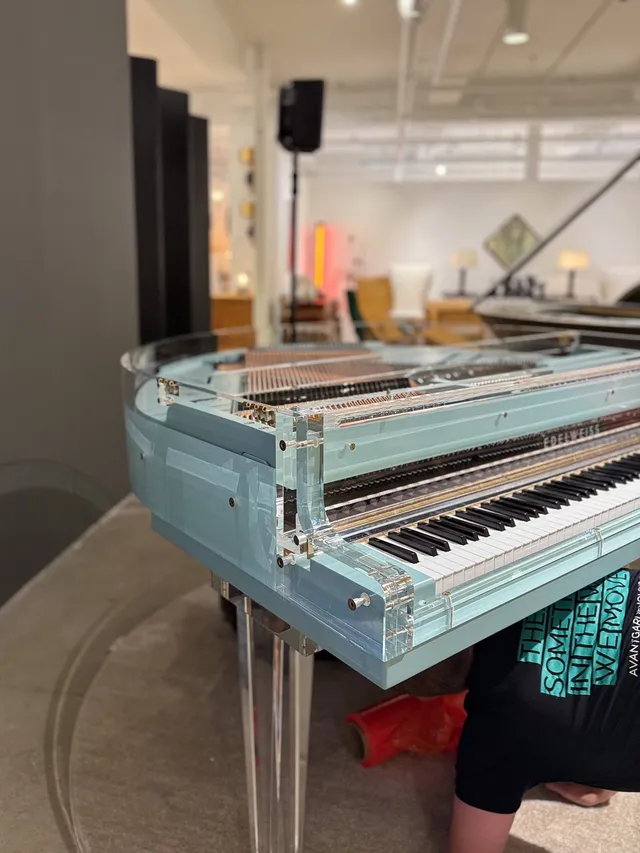

Moving a piano in NYC is rarely about the truck ride. It's about what happens at the doorway, the stairwell, the stoop, and the freight elevator at the other end. About 90% of the damage we see on piano jobs happens at thresholds, stair turns, and tight corners - almost none of it happens once the piano is wrapped, strapped, and rolling. If you're planning a piano move, the parts of the day that matter most are the first 30 feet and the last 30 feet.
Why pianos actually break (and it's not the truck)
People assume the dangerous part is the highway. It isn't. A properly tied-down piano on a padded skid in an air-ride truck is in one of the safest environments it will ever experience. The risk lives at every transition point: the lip of a doorway, the bottom step of a stoop, a 90-degree landing in a pre-war stairwell, the inch of clearance between the lid and a freight elevator's ceiling bracket.
That's where weight, geometry, and human fatigue all collide. A baby grand isn't just heavy, it's heavy in an awkward shape, with a center of gravity that wants to tip. When a crew is sweating through a 40-pound move-pad on a third-floor landing, the moment of risk isn't lifting. It's pivoting.
About 90% of piano damage happens within 30 feet of either curb. The truck ride is the easy part.
This is why our piano moving crews spend more time on a pre-move walkthrough than most movers spend on the entire job. Measuring the doorway is the warm-up. The real work is mapping every pivot point between the piano and the curb.
Upright, baby grand, concert grand, three different jobs
Owners often say "I have a piano." We always say "tell us what kind, and send a photo of the legs." Here's why that matters.
An upright piano runs roughly 300 to 500 pounds. Spinets and consoles sit on the lower end; a full studio upright or an old church-style upright can creep toward 600. A four-mover crew, a heavy-duty piano dolly, and a skid board are the baseline rig. Two movers carry, two spot the dolly and the corners.
A baby grand is 500 to 650 pounds, but the weight isn't the issue, the shape is. Grands get partially disassembled on site: legs come off, the lyre (pedal assembly) comes off, the lid is locked, and the body is laid on its straight side onto a padded skid board. That skid then gets wrapped, strapped, and dollied. Five movers minimum. Six if there are stairs.
A concert grand, your nine-foot Steinway D, your Bösendorfer Imperial, is 900 pounds and up. These are different animals. Six movers, sometimes seven, plus a foreman who does nothing but watch corners. We've done concert grands that needed to come through the parlor window of a Brooklyn brownstone on a hoist rig because the stairwell was a physical impossibility. That's not unusual. That's Tuesday.
Tell your mover the make, model, and year. "It's a piano" is not an estimate. It's a guess.
What changes when you live in a pre-war building?
Almost everything. Pre-war doorways in Manhattan and Brooklyn were built before the modern upright became standard furniture. We routinely measure parlor-floor doorways at 28 to 30 inches. A studio upright is often 24 to 25 inches deep, fine on paper. Add the moving pads, the corner protectors, and the angle of the dolly, and you're suddenly trying to push 28 inches through 28 inches.
Then there are the freight elevators. Most pre-war freight cars in the Upper East Side and Upper West Side have ceiling brackets, light cages, or service hooks that pianos do not clear. We've stood inside more than one freight elevator with a tape measure pointed straight up, calculating whether we can tilt the piano three degrees without snagging the emergency hatch. Sometimes the answer is no, and the piano has to come down the service stairs instead.
Stoops are their own category. A typical brownstone stoop in Park Slope or the Upper East Side has six to ten steps with a tight handrail on at least one side. A piano on a stoop needs at least one mover below the piano at all times, not braced against it, but actively bearing weight. That's an OSHA-territory job. The agency's ergonomics guidance on awkward heavy lifts is exactly the situation a stoop creates.
The hoist conversation
Sometimes the only sane way in or out is through a window. We've done parlor-floor hoists, second-story hoists, and once a fourth-floor hoist on Bank Street where the stairwell physically could not accommodate a baby grand at any angle.
A hoist requires:
- A street permit and sidewalk closure coordination, often through 311 and the NYC Department of Buildings
- A rigging crew separate from the moving crew
- A window large enough to receive the piano (often the lower sash gets removed)
- A weather window, no wind above ~15 mph, no rain
- A building that will sign off on the rigging plan
Hoists aren't exotic. They're just slow and weather-dependent. If your stairwell can't take the piano, plan two extra weeks into your timeline so the rigging permit and building approval don't ambush you.
What the homeowner needs to do before the crew arrives
You don't need to do much. But the small things matter.
- Lock the keyboard lid. If you don't have the key, tape it shut with painter's tape. A swinging fallboard can pinch fingers and crack the cheek blocks.
- Secure the pedals on a grand. The lyre comes off, but the pedals themselves should be wrapped or taped down so they don't swing during disassembly.
- Remove the music desk on grands. It's the most-broken part on every grand move, by a wide margin. Pull it out, wrap it in a moving pad, and set it aside.
- Photograph existing scratches and dings. Time-stamped phone photos. This is the same advice we give for antique furniture moves and for the same reason, you want a baseline before anyone touches it.
- Clear the path. Rugs rolled up, side tables moved, cords taped down. The crew shouldn't be improvising a path through your living room.
That's the whole list. Don't try to wrap it yourself. Don't try to remove the legs. The crew has the tools and the technique.
Tuning and acclimation, the part most owners get wrong
Here's the rule that surprises every first-time piano mover: don't tune it for two to four weeks after the move. A piano is a wooden instrument under tons of string tension. When it travels from a 65-degree apartment to a 72-degree one, or from Manhattan humidity to a dry suburban house, the soundboard expands and contracts. Tune it the day after the move and you'll be tuning it again two weeks later when the wood finishes settling.
Let it sit. Let it breathe in the new room. Then call the tuner. Most professional tuners will tell you the same thing, and the good ones will refuse to tune a freshly moved piano.
Pianos need to acclimate for 2–4 weeks after a move before tuning. Trying to shortcut this just costs you a second tuning visit.
Where you put the piano matters more than you think
The room is half the decision. The wall is the other half.
The single worst place to put a piano is against an exterior wall in a poorly insulated building, and most pre-war NYC buildings qualify. The temperature swing from a December cold snap traveling through that wall will detune the piano fast and, over years, can cause the soundboard to crack. Interior walls are always better.
The second-worst spots:
- Directly next to a radiator or steam pipe
- Under or near a window AC unit
- In direct sunlight from a south-facing window
- Across from a forced-air vent
Climate stability is the goal. If you have a humidifier in the apartment, that's a piano's best friend in a New York winter. If you have hardwood floors, the piano needs floor protection under the casters, both for the floor and to stop the casters from rolling under their own weight.
When you actually need a custom crate
Most local moves, apartment to apartment, borough to borough, don't need a crate. The piano gets pad-wrapped, skidded, and strapped. That's enough.
You need a custom-built crate when:
- The piano is going into storage for more than a few weeks
- It's traveling long distance on a shared truck
- It's going overseas
- It's a high-value heirloom and you want zero contact between the wood and any other surface
Crating a grand is a build job, frame the body, frame the lid separately, then assemble the crate around the piano on a custom skid. Same level of work as crating a significant piece of fine art. It's not a shortcut.
Insurance: declared value beats blanket coverage
This is the part nobody wants to read but everyone needs to. The standard movers' liability that comes with most jobs is calculated by weight under federal Released Value Protection, and on a 600-pound grand, the per-pound math works out to a settlement that won't replace the music desk, let alone the instrument.
For a real piano, you want declared value coverage with the actual replacement value of the instrument written into the contract before the job starts. A Steinway B is not interchangeable with a 1980s Yamaha upright. The paperwork has to reflect that. We walk every piano client through this before the crew is dispatched, and we cover the broader topic in our moving insurance guide.
Check the Better Business Bureau record on any mover you're considering. A clean BBB profile combined with verifiable piano references is the floor, not the ceiling.
Building requirements: the COI is non-negotiable
Almost every NYC building, co-op, condo, rental, doesn't matter, requires a Certificate of Insurance from the moving company before they'll let the crew use the freight elevator or block the loading dock. For piano deliveries the COI requirements often go a step further: some buildings require the mover's COI to specifically name the building, the management company, and sometimes the board, with minimum liability limits that are higher than a standard residential move.
We pull dozens of piano-specific COIs every month. The mistake we see owners make is assuming the standard moving COI will cover it. It usually doesn't. Send the building's insurance requirements to the mover at least a week out, we cover the full process in our NYC building rules and COI guide.
Why piano quotes are flat-rate (and why hourly pricing is a red flag)
A real piano move is quoted flat-rate, after a walkthrough or a detailed phone consultation with photos. The quote bakes in the crew size, the rig, the time, the building requirements, and any specialty equipment.
Hourly pricing on a piano job is a problem because the incentives are wrong. An hourly crew gets paid more if the job takes longer. A flat-rate crew gets paid the same whether they finish in three hours or six, which means they show up with the right number of movers and the right rig the first time. The math is the same logic we walk through in our professional packers vs. pack-yourself comparison, paying for expertise upfront is cheaper than paying for someone else's improvisation.
If a mover gives you an hourly rate for a piano job without seeing it, ask them how many concert grands they moved last month. The answer will tell you what you need to know.
Rented, owned, or heirloom, the risk profile changes
Not every piano on the truck is the same kind of risk.
A rented piano going back to a rental company has a clear chain of responsibility, the rental contract usually dictates how it has to be moved and by whom. Easy.
An owned piano that you bought new and use regularly is the standard case. Move it carefully, insure it properly, place it well, and tune it after acclimation.
An heirloom Steinway, your grandmother's 1923 Model M, or the upright that's been in the family since the Eisenhower administration, is a different conversation. The instrument's value isn't only monetary. We treat heirloom pianos the same way we treat irreplaceable art and what we describe in our white glove moving overview: individual planning, custom protection, no shortcuts. Pair the piano move with a list of items that don't belong in standard boxes if you're moving a whole household at once, heirloom-grade items need a separate plan from the rest of the load.
What to ask any NYC piano mover before you book
A short list. Use it on the phone.
- How many movers will be on the crew, and what's the rig?
- Have you moved this make and model before?
- Will you do a pre-move walkthrough of both addresses?
- What's your COI process and how fast can you turn one around?
- Is the quote flat-rate, and what would change it?
- What's your declared-value insurance option?
- Do you handle hoists in-house or subcontract them?
If you get clean answers to all seven, you're talking to a real piano mover. If any of those answers feel improvised, keep calling.
Frequently Asked Questions
How long does a typical piano move take in NYC?
For an upright between two elevator buildings in Manhattan, plan on two to three hours door-to-door. A grand piano with stairs at one end can run four to six. A hoist job with permits and a sidewalk closure is a half-day minimum. The variance comes from access, not distance, a move from the Upper West Side to Brooklyn Heights is often faster than a move between two apartments in the same building if one has a freight elevator and the other doesn't.
Can I move my piano myself with a few friends?
Honestly, no. We've been called to repair the aftermath of DIY piano moves more times than we can count. The weight is one thing; the geometry is another; the liability for a stairwell injury is a third. Even if the piano survives, your back, your floors, and your friendships might not. Call a professional piano crew.
Do I need a different mover for a piano than for the rest of my household?
Not usually, most full-service NYC movers have piano crews on staff. What matters is whether the same company can dispatch a piano-trained crew on the same day as your household move, so the piano doesn't show up to an empty apartment or get held back while everything else goes ahead. Coordinated scheduling is the whole game.
What about moving a piano out of the city, to the suburbs or another state?
Long-distance piano moves are a different rig. The piano gets crated or heavily skidded, secured in a climate-aware truck, and tracked separately from the rest of the load. Our long-distance moving service handles the routing, and the white-glove team handles the prep on both ends. If the destination is overseas, the piano almost always crates.
When should I book a piano move?
For local NYC moves, two to three weeks out is comfortable, that gives the building enough time to process the COI and reserve the freight elevator. Hoists need four to six weeks because of permits. Heirloom-grade or concert grands should be booked as soon as you have a date, because the right crew for a Steinway D doesn't sit around waiting for last-minute calls.
Pianos are the most rewarding thing we move and the most unforgiving. The instruments outlast the apartments they live in, the owners who play them, and usually the moving companies that handle them. If you're planning a move and you have a piano in the picture, whether it's a studio upright in a Williamsburg one-bedroom or a Steinway D coming out of a Fifth Avenue penthouse, reach out to us at Avant Garde Moving and we'll talk through the building, the rig, and the day. We'd rather spend an hour on the phone before the move than an hour on the phone after.