

A painting is a flat rectangle. You can face it, corner it, and stand it on edge. A sculpture gives you none of that. It has no flat face and no frame. It may have an arm, a wing, or a thin rod sticking out. And it can put a few hundred pounds on a base the size of a dinner plate.
This guide covers how to move a sculpture in New York City: handling by material, estimating weight, packing, getting it out of the building, and setting it down safely at the other end.
The Short Answer
Find out what it is made of and what it weighs before anyone touches it. Lift from the base, never from a projecting part. Crate anything heavy, fragile, valuable, or going into storage. And sort out insurance first, because a mover's basic liability is tied to weight, not value.
| Question | Short Answer |
|---|---|
| Where do you lift it? | Near the base, by solid areas. Never by arms, handles, or other projections. |
| Gloves or bare hands? | Gloves for metal, stone, plaster, and polished surfaces. Not cotton on glass or glazed ceramic. |
| Soft pack or crate? | Soft pack for small, sturdy pieces on a short direct trip. Crate the rest. |
| Can it go out the window? | Only with a licensed rigger. That is a city rule, not a preference. |
| Is it covered? | Basic mover liability is 60 cents per pound. Declare the value and check your own policy. |
Why Sculpture Is Harder to Move Than Paintings
The weight sits on a small footprint. A stone bust on a narrow socle is top-heavy.
The parts that stick out are the weak parts. The Canadian Conservation Institute warns that attachments and protruding parts may no longer be able to hold an object's weight, and that convenient handholds "should always be suspected of being fragile."
The surface is the artwork. A bronze patina is not dirt. The institute's guide to metal objects describes it as a layer that "enhances the metal object and should not be removed."
Our guide to moving fine art in NYC covers paintings and works on paper. This post picks up where that one stops.
How to Handle a Sculpture, Material by Material
Two rules apply to everything. Lift near the base, by solid areas. And lift, never drag.
Bronze and Other Metals
Wear gloves. The Canadian Conservation Institute says to avoid touching metal with bare hands, because fingerprints can stain and even etch the surface. It recommends clean nitrile gloves. And do not polish a bronze before a move. You may be removing the patina.
Marble and Stone
Stone looks tough, but it is porous. The National Park Service notes that oils from repeated handling cause stains, usually on the parts people touch most, like noses and knees. Its handling rules for stone: wash your hands, wear clean gloves, and "never lift by projecting parts such as arms, legs, or wings."
The same guide warns that old repairs may not be stable, and that any strap touching stone needs padding so it cannot slip and scratch.
Plaster
The Canadian Conservation Institute's note on plaster of Paris objects calls bare plaster "very porous and hygroscopic." Water leaves tide lines and stains. Skin oils soak in. Wear clean gloves and keep it dry.
Hollow casts can be very thin in wide, flat areas. The note also warns that heavy works "often suffer repeated damage from prying on the underside edges" when people try to get a grip. Do not lever it up.
Ceramic, Terracotta, and Glass
Here the glove rule flips. The National Park Service says not to wear cotton gloves on glass or ceramics, because the surfaces are slippery. Use clean, bare hands or snug nitrile gloves. Do not lift by handles, knobs, or rims. If a part lifts off, like a lid or a separate base, it travels separately.
Wood
The Canadian Conservation Institute explains that wood changes size as relative humidity changes, and that wood assemblies may "crack, split, delaminate, or distort permanently." Do not leave a wooden sculpture in a cold truck overnight and then set it by a radiator.
Resin, Mixed-Media, and Kinetic Work
Treat cast resin and acrylic like a polished surface. The Metropolitan Museum of Art's care and handling guide says nitrile gloves should always be worn for metal and plastic objects.
Anything that swings, spins, or hangs has to be stopped before it moves. The Canadian Conservation Institute's rule: the parts of an object should move as one, unless they can be separated and moved individually. If the piece has wiring or a motor, photograph every connection before anything is unplugged.
Assess the Piece Before You Move It
Estimate the Weight
Do not guess. The National Park Service publishes a simple method for calculating the weight of stone: measure length, width, and height in feet, multiply for cubic feet, then multiply by the stone's weight per cubic foot.
| Material | Weight |
|---|---|
| Marble | 150 to 179 lb per cubic foot |
| Granite | 159 to 180 lb per cubic foot |
| Limestone | 150 to 179 lb per cubic foot |
| Cast tin bronze | About 0.317 lb per cubic inch |
The stone figures are from the National Park Service. The bronze figure is the Copper Development Association's listed density for a tin bronze casting alloy. It works out to roughly 548 pounds per cubic foot.
A quick example. A marble block 1 foot by 1 foot by 2 feet is 2 cubic feet. That is 300 to 358 pounds. A carved figure weighs less than the block it fits inside, so treat that as your ceiling.
Bronze is trickier, because a bronze can be cast solid or hollow. Check the gallery paperwork or an old shipping record for a stated weight.
Find the Center of Gravity and the Weak Points
Before the lift, answer three questions:
- Where is the weight? Top-heavy pieces need to be controlled high and supported low.
- How is it mounted? Many sculptures are pinned or bolted to a base or pedestal. Look underneath before you lift.
- Does it come apart? If it was built to separate, moving it in sections is usually safer.
Document the Condition
Photograph every side, the top, and every chip, crack, and old repair. Write down the dimensions and the weight. Date it. This is your baseline if you ever need to make a claim.
How to Pack a Sculpture for Moving
Soft Wrap for Small, Sturdy Pieces
A small, solid piece on a short, direct trip can travel soft packed. Start with a smooth layer of tissue against the surface, then padding, then a rigid box.
The National Park Service's packing chapter gives numbers you can use. Leave at least two inches of cushioning between the object and the walls of the container. Allow three to four inches for very fragile items like ceramics and glass, and for heavy objects. It also says loose foam peanuts are usually not appropriate. They can get caught in projecting parts.
Cavity Packing and Double Boxing
Cavity packing means cutting a hollow in layers of polyethylene foam to the shape of the object, then lining the hollow with tissue or Tyvek.
Double boxing means packing the object in one box, then floating that box inside a second one at least two inches larger on all sides.
When You Need a Custom Crate
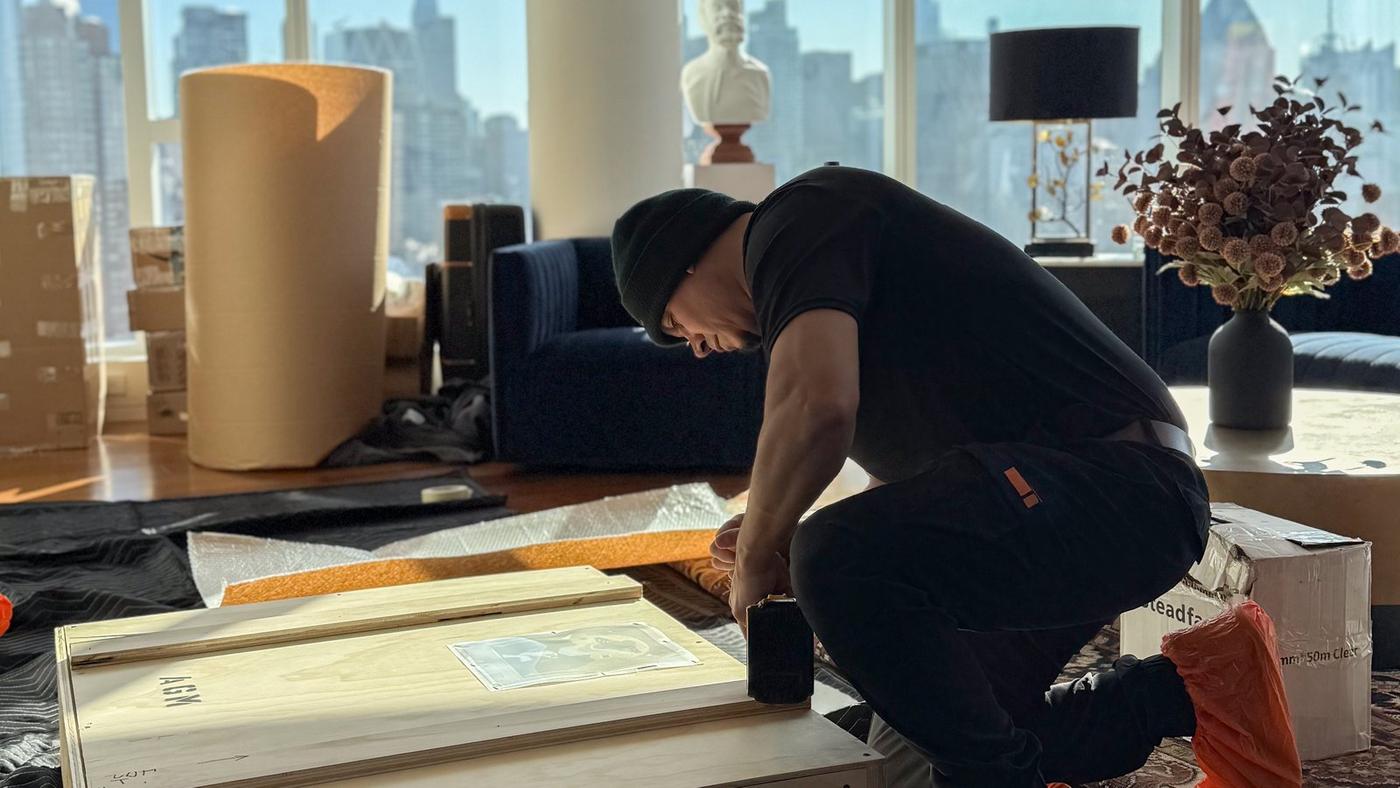
Crate it if it is heavy, fragile, high in value, oddly shaped, going into storage, or traveling a long way. A sculpture crate is built around the piece. The base carries the weight. Padded braces hold it at its strong points. Nothing touches the projections.
For a heavy stone piece, the crate usually sits on skids so a pallet jack can get under it. Some works travel better fixed to a rigid travel frame, so the frame is what gets handled.
We build these through our custom crating service, in the workshop or on site when a piece should not travel bare. For how crates are constructed, see what gets crated and why.
Getting It Out of a NYC Building
Know the path before you start. Check door heights and widths, and make sure there is room to turn corners. In New York, add these:
- Measure the crate, not the sculpture. The crate is what has to fit the doorway and the elevator.
- Check the elevator's rated capacity. Count the piece, the crate, the dolly, and the people riding with it.
- Protect the floors. A heavy piece on small wheels puts a lot of load on a small spot. Lay down panels to spread it.
- Ask about floor load for very heavy work. For a large stone or metal piece, the building's engineer or managing agent should confirm where it can travel and where it can sit.
When It Will Not Fit: Rigging and Hoisting
Some pieces are too big or too heavy for the elevator and the stairs. Then it goes out through a window or over a terrace. This is not a moving-crew job. New York City requires a rigger license to hoist or lower any item on the outside of a building. A Special Rigger can hoist items up to 2,000 pounds. A Master Rigger license is needed above that. A hoist may also mean closing part of the sidewalk or street, which can require its own city permits.
For larger projects, we cover scheduling and access in our guide to moving an art collection or gallery.
Transport
On the truck, the crate gets strapped to the wall. The strap never touches the artwork, and nothing gets stacked on top. Air-ride suspension cuts down on road shock. Climate control matters most for wood, plaster, and painted surfaces.
Installing It at the Destination
Our installation service handles placement and mounting. Here is what to plan for.
- The pedestal and floor. The pedestal has to carry the weight and be wide enough that a bump cannot tip the piece. The floor-load question from the old building applies in the new one.
- Anchoring. Tall or top-heavy pieces are often pinned or bolted to the base. Use the original mount if there is one.
- Small works. Museum wax is widely used to hold small objects in place. A study from New Zealand's national museum found it can be effective for smaller glass items, but that waxes can also damage the surface or structure of fragile objects. Keep it off porous or painted surfaces unless a conservator says otherwise.
- Outdoor pieces. A terrace or garden adds wind and water. Plaster does not belong outside. Stone and bronze need a stable, level footing.
Check the piece against your photos before the crew leaves.
Insurance and Valuation
Under the federal rules for interstate moves, the no-cost option is called Released Value Protection. The Federal Motor Carrier Safety Administration states that under it, the mover is responsible for no more than 60 cents per pound per article. A 300-pound marble sculpture would be covered for $180. A 40-pound bronze would be covered for $24.
Full Value Protection is better, but it has a catch for art. The same agency says movers may limit their liability for items of "extraordinary value," meaning items worth more than $100 per pound, unless you list them. Declare valuable pieces in writing before the move.
Then call your own insurer. A fine-art policy or a scheduled rider on a homeowners policy is usually what protects a valuable piece. Ask whether it covers transit and storage. Our moving insurance guide explains valuation versus insurance in plain terms.
If the Sculpture Is Going Into Storage
Store it crated or on a padded, stable support, and keep the climate steady. The National Park Service's general guidance for ceramic, glass, and stone is a stable temperature and humidity, with no more than a 5 percent swing in humidity in a day. For pieces that combine stone or ceramic with organic materials like wood, it says to use the conditions the organic material needs. Our fine art storage page covers climate-controlled holding.
Frequently Asked Questions
How do you move a heavy sculpture?
Work out the weight first. Lift near the base with enough people, and get it onto a padded dolly quickly. Very heavy pieces need equipment like a pallet jack or forklift and experienced handlers. Never drag it.
How do you pack a sculpture for moving?
Wrap it first in a smooth layer like tissue, then cushion it so nothing presses on fragile parts. Leave at least two inches of padding on every side, more for fragile or heavy pieces. Use a custom crate for anything heavy, fragile, or valuable.
Can movers hoist a sculpture through a window in NYC?
Only with a licensed rigger. New York City requires a rigger license to hoist or lower any item on the outside of a building. Art handlers prepare and crate the piece, and the rigging company runs the lift.
How much does it cost to move a sculpture in NYC?
It depends on the piece. Weight, fragility, crating, building access, rigging, crew size, and installation all change the number. Ask for a written quote based on photos and dimensions.
Is my sculpture covered if the movers damage it?
Not well, by default. Released-value coverage pays no more than 60 cents per pound per article. Declare high-value pieces in writing, and confirm that your own fine-art or homeowners policy covers the move.
The Bottom Line
Moving a sculpture is mostly decided before the lift. Know the material, the weight, and the weak points. Photograph it. Then pack it so the strong parts carry the load and the fragile parts touch nothing.
In New York, the building is the second half of the problem. Measure the crate against the doors and the elevator, protect the floors, and bring in a licensed rigger if it has to go outside. And settle the insurance question while the piece is still on its pedestal.
This is general guidance. For a fragile, damaged, or very valuable piece, talk to a conservator before it moves.
Have a sculpture to move, crate, or install? Avant-Garde Moving's fine art movers handle sculpture across New York City, from a single tabletop piece to large stone and mixed-media work. Send us the dimensions and a few photos when you request your free quote.

