
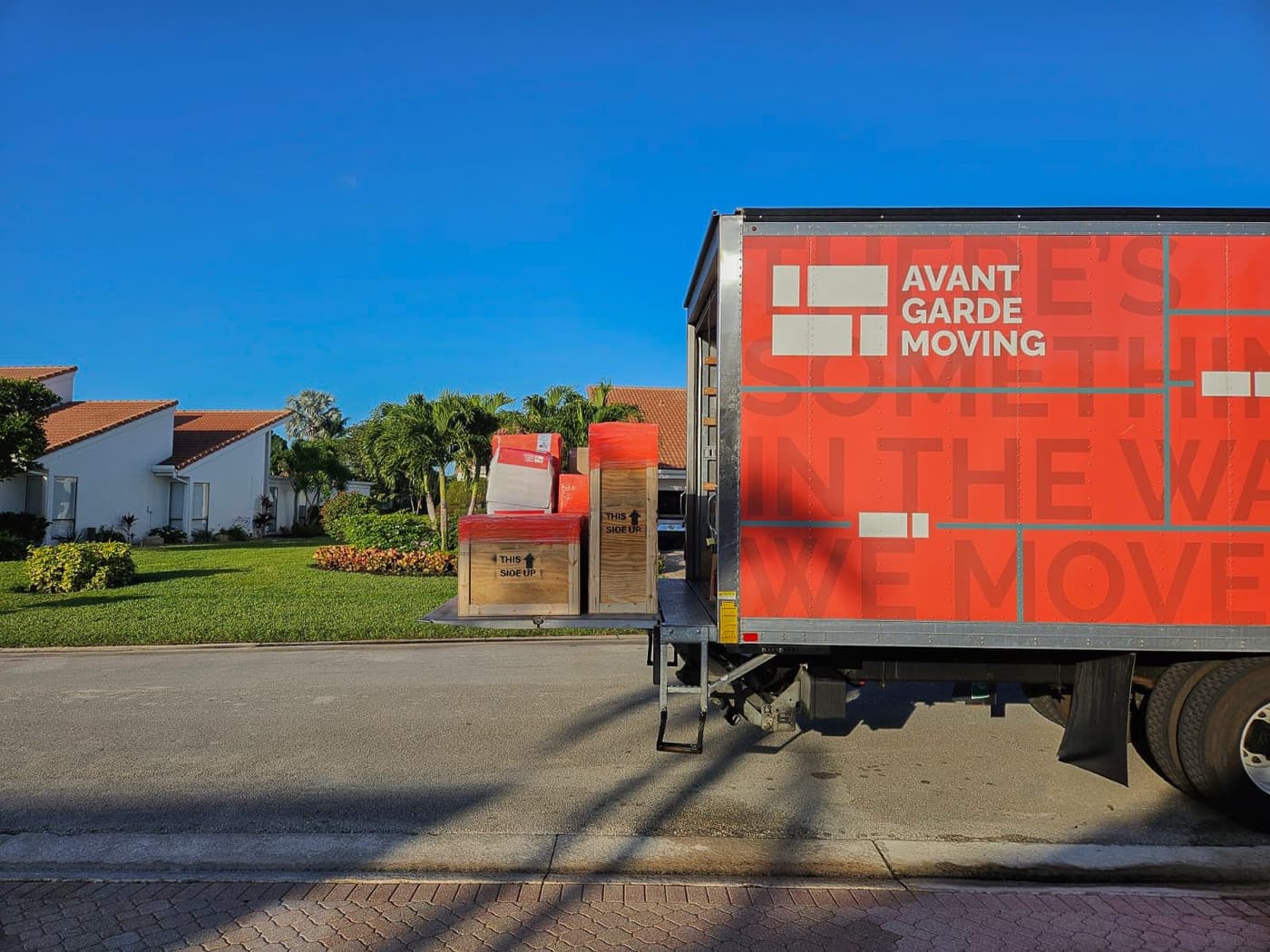

A NYC to San Francisco move is not just a long-distance haul - it's a full reset. The furniture decisions, the transit window, the parking permits on a steep block off Divisadero, and the pace of the destination city all play differently than an East Coast relocation. About 40% of the long-distance jobs we book between March and June are NYC to the Bay Area, and almost every one starts with the same set of bad assumptions. This is the playbook we wish every East Coaster had before they signed a lease on a Noe Valley flat sight unseen - no dollar figures, just the logistics, the decisions, and the surprises that bite hardest at 3,000 miles of distance.
How long does the move actually take, door to door?
The honest answer for a coast-to-coast move is transit times are a window, not a date. From a NYC pickup to an SF delivery, plan on anywhere from 7 to 14 calendar days in the truck depending on how your shipment is loaded and routed. That window is the single biggest source of friction in this entire process, and it deserves its own conversation early.
Backwards-plan from your SF lease start. If you are starting work on a Monday, you do not want your stuff scheduled to arrive that same Monday. Build slack on both sides. Most of our clients fly out 3 to 5 days ahead of the truck and live out of two suitcases and an air mattress while they wait. That gap is also when you handle DMV stuff, walk the new neighborhood, and figure out which corner store sells the good eggs.
Start serious planning 10 to 12 weeks before your target move date. NYC pickup days in late spring book out fast, and SF delivery slots into hilly neighborhoods are a separate constraint your mover has to solve.
If you want a deeper look at how booking lead times compress in spring and early summer, our piece on how far in advance to book movers walks through the calendar tradeoffs. For the broader cross-country mental model, the ultimate state-to-state relocation guide is the companion read.
Dedicated truck or consolidated load, which one are you actually buying?
This is the single most important question on a cross-country move and most people do not even know it is being asked. When you book long-distance moving, your shipment goes onto the truck in one of two ways.
Dedicated means your stuff is the only shipment on the truck. The driver leaves NYC, drives to SF, and delivers. The window is tight, usually 4 to 6 days, and you can almost name the delivery date. It costs more, but the certainty is the product.
Consolidated means your shipment shares the trailer with two or three other households heading to the West Coast. The truck loads in NYC, picks up or drops off along the way, and your delivery window stretches to that 7 to 14 day range. It is the standard option, and for most one-bedroom and studio moves it is the right call. Just understand the tradeoff before you sign, read what a moving estimate actually covers so the numbers and dates on the page mean what you think they mean.
Ask your mover, in writing, whether your move is dedicated or consolidated and what the first available delivery date and last guaranteed delivery date are. Those two dates are your real planning constraints.
What to ship, what to sell, what to store
The instinct of every NYC apartment-dweller is to ship everything because they fought hard to acquire each piece. Resist that instinct for a week and look at your stuff with new eyes.
San Francisco apartments are a different beast. Kitchens are often smaller than you expect, Victorian and Edwardian conversions cut original rooms in half, and a lot of "1-bed" units have galley kitchens with maybe four feet of counter. Closets in pre-war SF buildings are tiny, sometimes nonexistent. Ceilings can be lower in garden units. Your IKEA Pax wardrobe that fit your Williamsburg loft will not necessarily clear the doorframe of a Lower Haight flat.
Things worth shipping: anything custom, anything sentimental, anything you bought at full price in the last three years, all your books if you actually read them, your good knives, your bike. Things to seriously reconsider: window AC units (most SF apartments do not need or want them), humidifiers (you will not need one), heavy winter outerwear past one good coat, that giant West Elm sectional if it had to be hoisted in NYC.
If you are torn, our storage solutions buy you time. A common pattern: ship the must-haves, put the maybe-pile in a NYC storage unit for 90 days, and reassess from California once you have lived in the new place. Our breakdown of storage versus moving everything is the right read before you commit either way.
A short list of things East Coasters routinely overpack:
- Salt-rated winter boots (SF does not salt roads, there is no slush)
- Heavy curtains for radiator heat (most SF rentals have wall heaters or none)
- Box fans (the marine layer does the work)
- Snow shovels and ice melt (you can guess)
For art, instruments, and anything that matters, do not improvise. Our fine art movers and white glove moving crews handle the pieces that cannot be replaced. And for the items that genuinely should not go in a standard box at all, the list in items to never pack in standard moving boxes is required reading.
How packing changes when the truck is on the road for a week
A NYC-to-Brooklyn move is over in four hours. A NYC-to-SF move puts your belongings through 3,000 miles of expansion joints, mountain passes, temperature swings, and at least one transfer between trucks if you are on a consolidated load. Stuff shifts. That is the part people do not internalize.
What this means in practice: every box must be packed to the top. Air space is the enemy on long hauls because items rattle, settle, and grind against each other for days. We use crumpled paper, foam peanuts, or soft goods to fill every gap. Half-full boxes get repacked. Plates go on edge, not stacked flat. Glassware gets cell partitions. Lamps come apart, bases boxed separately from shades. TVs ride in their original boxes if you have them, or in custom-fit cartons.
Mattresses get bagged. Upholstery gets shrink-wrapped over moving blankets, never directly on fabric (condensation in the trailer can mildew anything wrapped in plastic against bare cotton or linen). Wood furniture gets blanket-wrapped at minimum, and anything with a finish you care about gets custom crating for the trip.
This is the moment most people decide whether professional packers or self-packing is the right call. For a local move, packing yourself is usually fine. For a cross-country move, the calculus shifts hard. Our packing and unpacking crews pack to long-haul standards, meaning your boxes are built to take a week of vibration, not a 20-minute van ride to Park Slope.
San Francisco move-in day: the part nobody warns you about
This is where the East Coast brain breaks. NYC moving logistics are about COIs, freight elevator reservations, and alternate-side parking. SF moving logistics are about gravity, geometry, and parking permits.
Streets and hills
Half of San Francisco is built on hills. Some streets in Pacific Heights, Russian Hill, and Bernal Heights have grades steep enough that a 26-foot truck physically cannot park parallel without the rear bumper scraping pavement. Your driver will know this; if they do not, that is a flag. On the steepest blocks, the truck parks on a cross street and the crew walks the goods up.
Victorian and Edwardian walk-ups
A huge share of SF housing is two- and three-flat Victorians with narrow staircases that turn 180 degrees on a tight landing. Your couch may need to go up over the railing or, in some cases, in through a bay window with a hoist. We measure landings before move day and flag pieces that will not make the turn. This is the SF equivalent of the NYC freight elevator conversation, and it lives or dies on pre-move recon.
No driveway, no doorman, no easy answer for parking
Most SF residential streets have zero off-street parking at older buildings. You cannot just pull a moving truck up to the door and unload. You need a temporary moving permit from the San Francisco Municipal Transportation Agency, and you need to apply for it well in advance of move day. SFMTA issues these permits with signage that has to be posted on the curb 72 hours before the move so that resident vehicles can clear out. If you skip this step, your truck circles for an hour and your crew loses half a day. We handle the permit on every SF delivery, but you should know the system exists.
No doorman means no package pickup
This is the lifestyle shock that hits hardest in the first month. Coming from a NYC building with a doorman or concierge, you forget how much logistical work that one person quietly absorbed. In SF, your packages get left on the stoop. Your dry cleaning is not signed for. Your furniture delivery cannot be received in your absence. You start coordinating around delivery windows the way you used to coordinate around laundry day.
For a comparable move-day complexity profile from a different angle, the NYC to LA cross-country guide is worth a skim, many of the same dynamics apply, but SF parking and hill grades are their own animal.
What changes about the weather, and what that does to your stuff
San Francisco weather is the inverse of NYC weather in almost every way that affects belongings. NYC is humid in summer, bone-dry and overheated in winter. SF is mild and dry year-round, with a marine layer that rolls in most summer mornings and burns off by noon.
Things this changes: wood furniture stops cracking from radiator heat in winter, but it may also stop swelling shut in summer humidity (drawers that stuck in NYC will glide in SF). Leather stays supple longer. Houseplants that struggled in NYC dry winter air will thrive. Salt corrosion on bikes, tools, and metal furniture stops being a thing, there is no road salt and no winter slush.
What it does not change: fog is wet. If you live in the Sunset, the Richmond, or anywhere west of Twin Peaks, the marine layer means damp evenings and mornings for months. Closets without ventilation grow mildew. Leather shoes need cedar. Books on outside walls of garden units can buckle. None of this is catastrophic; it is just different. The National Weather Service NYC office tracks the climate you are leaving behind if you want a side-by-side baseline.
For valuables that are sensitive to environmental swings, our fine art storage facilities are climate-controlled if you need a buffer between leaving NYC and your SF apartment being ready.
The paperwork: USPS, DMV, taxes
Three pieces of admin matter for a cross-country move and most people forget at least one of them.
USPS forwarding. File your USPS change of address about 10 days before your NYC move-out date. Forwarding lasts 12 months and gives you runway to update everyone who still has the old address.
California DMV. California gives new residents 10 days to apply for a CA driver's license once you establish residency, and 20 days to register your vehicle if you are bringing a car. Both of these clocks start the day you "establish residency," which California defines loosely but in practice means the day you sign a lease or start a job. If you are not bringing a car (most NYC transplants are not), the DMV step is just the license. Book the appointment online before you fly out, walk-ins can lose you a day.
Taxes and the moving deduction. For most filers, moving expenses are not federally deductible anymore, but if you are an active-duty military member, IRS Form 3903 still applies. Worth a glance with your accountant. Either way, save every receipt, California has its own rules and a few employer-paid relocation packages get treated differently for state income tax.
If you have not already, also worth reviewing moving insurance options before the truck pulls away. Cross-country shipments expose your goods to more handling than any local move, and the default valuation coverage on long-haul carriers is usually not enough for a household of NYC-quality furniture.
What NYC habits are you going to drop?
A few habits we watch transplants shed in the first 90 days:
The late-night everything. SF goes to bed earlier than NYC. Last call is 2 a.m. but most kitchens stop seating at 9:30. The bodega run for ice cream at midnight is not really a thing.
The walking-as-default. SF is technically walkable, but the hills mean you actually plan routes. The 22-Fillmore bus replaces the L train in your mental model. Muni and BART will become normal but they are not the subway. Frequencies are thinner and the system stops earlier.
The loud apartment lifestyle. NYC apartments have thick old walls and you can hear your neighbors but they expect you. SF Victorians have famously thin floors. Your downstairs neighbor will hear you walk in heels at 7 a.m. Buy rugs.
The doorman safety net. Already covered above, but worth saying twice. Build new systems for packages, Amazon Lockers, work delivery, neighbor coordination, a porch lockbox.
For East Coasters who lived in classic NYC neighborhoods like the Upper East Side or Williamsburg, the adjustment is less about square footage and more about the rhythm of building life. SF residential buildings are smaller, quieter, and far more self-service.
Things East Coasters routinely underestimate
Earthquake prep. You do not need a bunker. You do need to anchor tall bookshelves to wall studs, keep a flashlight and water under the bed, and not store heavy objects on shelves above where you sleep. Your mover can install furniture straps during delivery, ask.
Hill grades for furniture delivery. That sectional you finally agreed to ship? Make sure the SF crew can physically get it through your front door, up the stoop, around the landing, and into the room. We do a virtual walkthrough of the new place before we load the truck in NYC, because the worst time to find out a piece does not fit is when it is sitting on the sidewalk on Page Street.
Kitchen size differences. Bring your good knives, your cast iron, your one nice pot. Leave the third sheet pan, the bread machine you used twice, the standing mixer if you bake once a year. SF kitchen storage is not generous.
The fog feels colder than the temperature reads. Sixty degrees with marine layer wind on Ocean Beach is a different sixty than sixty in Prospect Park. Pack one real jacket even if you are moving in summer.
The first month is logistically harder than emotionally hard. Most transplants we move expect homesickness. What actually hits is decision fatigue from rebuilding every routine, pharmacy, doctor, bank branch, gym, coffee shop, dry cleaner, vet, all from scratch, all in the same two weeks.
Frequently Asked Questions
How early should I book a NYC to San Francisco move?
For a target pickup in spring or early summer, start conversations with movers 10 to 12 weeks out, and lock in your booking at least 6 weeks before pickup. Cross-country routes have fewer trucks running than local NYC moves, and dedicated trucks sell out first. If your timeline is tighter, consolidated loads usually have more flexibility but a wider delivery window.
Should I drive my car to San Francisco or ship it?
Most NYC transplants do not bring a car at all, SF is one of the few US cities where car-free living genuinely works, and street parking in dense neighborhoods is brutal. If you are bringing one, shipping is almost always easier than the cross-country drive. The drive sounds romantic in March; by hour nine of Nebraska it stops being romantic. Coordinate the car shipper to deliver a few days after you arrive so you have somewhere to park it.
Do I need a temporary parking permit for the moving truck?
Yes, on most SF residential streets you do. The SFMTA temporary moving permit reserves curb space and requires posted signage 72 hours in advance. Skipping the permit means your truck circles for parking on move day, the crew burns billable hours, and your neighbors hate you. A reputable mover handles the permit as part of the delivery setup.
What is the difference between dedicated and consolidated cross-country shipping?
A dedicated truck carries only your shipment from NYC to SF, with a tight delivery window of 4 to 6 days. A consolidated truck shares the trailer with other households heading west, costs less, but stretches the delivery window to 7 to 14 days. Neither is universally better, the right choice depends on whether your priority is delivery date certainty or budget flexibility.
What should I get rid of before moving from NYC to San Francisco?
Window AC units, humidifiers, heavy snow gear past one coat, ice melt, anything that only made sense because of NYC humidity or radiator heat. Also seriously evaluate oversized furniture, SF Victorians have narrow staircases and tight landings, and pieces that were a struggle to get into a NYC walk-up will be a worse struggle going up a Victorian's turning staircase. When in doubt, store it in NYC for 90 days and decide from California.
If you are thinking through a NYC-to-SF move and want a real conversation about the tradeoffs, dedicated versus consolidated, what to ship versus store, how to handle the SF parking permit and Victorian walk-up, that is the conversation we have every week. Reach out to Avant Garde Moving and we will walk you through your specific timeline, building, and shipment. No pressure, no canned pitch, just the playbook from a crew that has done this route a few hundred times.