
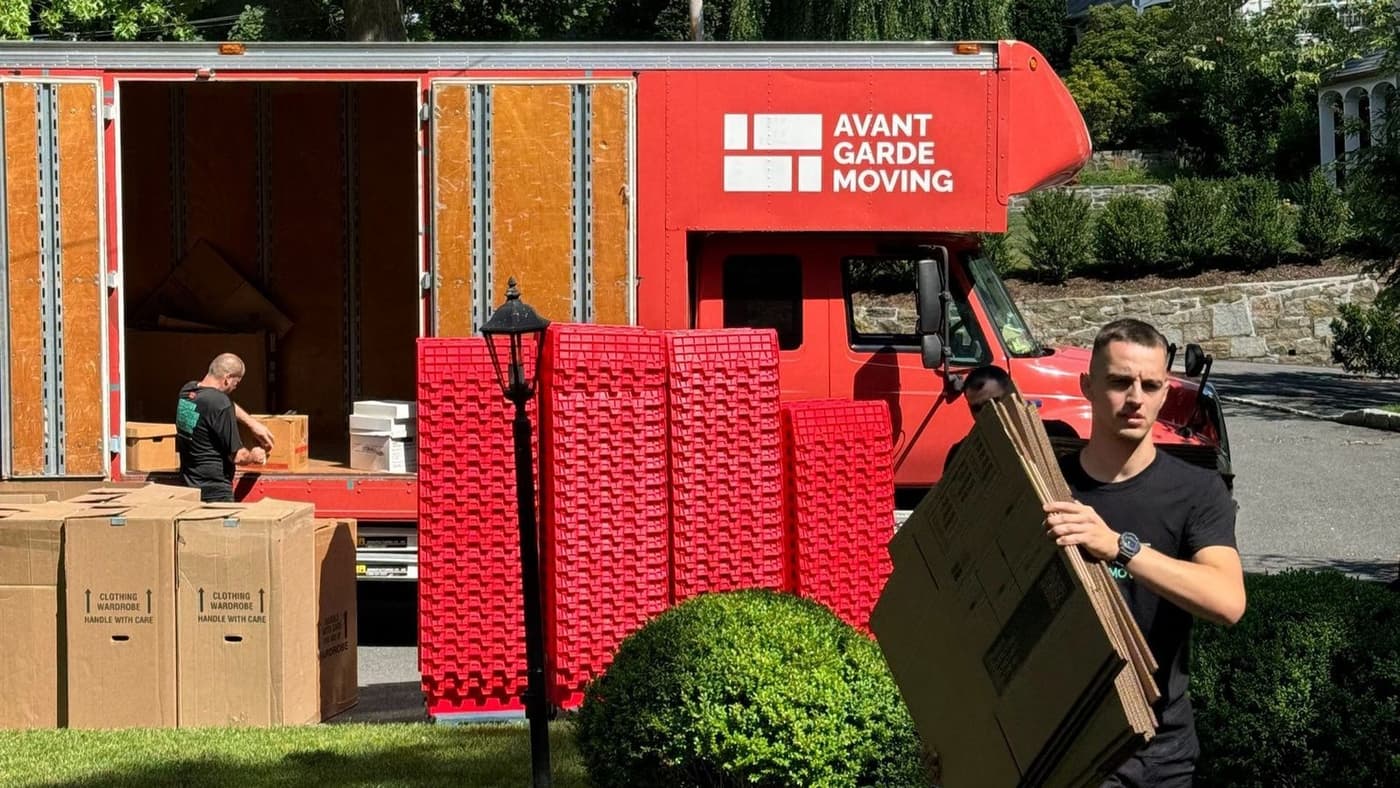

A rental truck in New York is advertised at $19.95. A moving crew for the same studio costs hundreds of dollars. On paper, that is not a contest.
But nobody moves on paper. In this city the truck has to follow truck routes, stay off the parkways, find a legal spot on a block with no spots, and get past a doorman who wants a Certificate of Insurance you cannot produce. Most guides on this topic are written for a suburban driveway. New York is not a driveway.
We are a moving company, so you know where we stand. We will still give you the honest numbers. By the end of this guide you will be able to price your own DIY move line by line, compare it to what movers actually charge, and know which option fits your apartment and your buildings.
The Short Answer
Renting a truck is much cheaper in cash. For a studio inside Brooklyn, the truck, mileage, gas, and equipment come to about $70 before tax and damage coverage. A crew costs $500 to $1,200 for a studio and $1,000 to $3,000 for a two-bedroom, depending on the season.
What decides it in NYC is not the price. It is whether your buildings will let you move yourself without a mover's COI, whether you can drive a 10 to 20 foot truck legally through the city, and whether you have three or four strong friends free for a full day. If the answer to any of those is no, the savings disappear fast.
What Renting a Truck in NYC Actually Costs
Every in-town rental works the same way. U-Haul says it plainly in its truck rental FAQ: in-town rates are a flat fee for the rental period plus a per-mile charge. Penske and Budget quote local rentals the same way, by location and date, at booking.
Here is what U-Haul's own rate page quoted us in October 2026 for a weekday pickup in mid-November, with sizing from U-Haul's truck comparison page. Taxes and damage coverage are not included.
| Truck | Base Rate | Per Mile (Brooklyn 11222) | Per Mile (Manhattan 10011) | U-Haul Says It Fits |
|---|---|---|---|---|
| 10-foot | $19.95 | $1.79 | $2.29 | Studio or 1-bedroom apartment |
| 15-foot | $29.95 | $1.79 | $2.29 | 1-bedroom home or 2-bedroom apartment |
| 20-foot | $39.95 | $1.79 | $2.29 | 2-bedroom home or 3-bedroom apartment |
- The base rate is the small part. The miles are where the bill grows. Count every mile: lot to old place, to new place, any second trip, and back to the lot.
- Weekends cost more per mile. The same quote listed $1.99 in Brooklyn and $2.49 in Manhattan on weekends.
- Rates change. Treat the table as a snapshot and get your own quote for your date.
The Rest of the DIY Bill
| Cost | What It Runs | Source |
|---|---|---|
| Environmental fee | $1 per in-town rental | U-Haul quote |
| Gas | Miles ÷ MPG × price per gallon | NYC regular averaged $4.31 the week of Oct. 12, 2026 (EIA). U-Haul rates its trucks at 10 to 12 MPG. |
| Dollies and pads | Utility dolly $7, furniture dolly $7, appliance dolly $10, furniture pads $10 | U-Haul quote |
| Damage coverage | Priced at the counter | See below |
| Tolls | Truck rates, not car rates | Below |
| Parking tickets | $65 to $115 each | NYC Department of Finance |
| Helpers | Pizza, or a labor-only crew | Below |
Gas is rarely the problem on a local move. Thirty miles in a 15-foot truck is about three gallons. You must also return the truck with the same amount of fuel it had at pickup.
Damage Coverage Is Not Optional in Practice
U-Haul's damage coverage page warns that many personal auto policies exclude rental trucks, and that you are responsible for all damage to the equipment. Its Safemove plan adds a damage waiver, limited cargo protection, and medical coverage for people in the cab. In New York the deductible is $150, and overhead damage carries a $250 deductible. Only Safemove Plus covers overhead damage in full.
Read that cargo line closely. Safemove covers your belongings for collision, fire, windstorm, and overturn. It does not cover a dresser your friend drops on the stairs, or damage from shifting cargo.
The Tolls on a Rental Truck
A box truck pays truck tolls, not car tolls. The MTA only counts a two-axle vehicle as a car if its maximum gross weight is 7,000 pounds or under. U-Haul lists even its 10-foot truck at an 8,600-pound gross vehicle weight.
For 2026, the MTA truck rates for a 2-axle truck at the RFK, Bronx-Whitestone, Throgs Neck, and Verrazzano-Narrows Bridges and the Queens Midtown and Hugh L. Carey Tunnels are:
- $13.49 with a NY E-ZPass
- $24.07 by mail or with an out-of-state E-ZPass
On top of that, any truck entering Manhattan at or below 60th Street pays the congestion toll: $14.40 at peak for a single-unit truck, $3.60 overnight. Peak runs 5 AM to 9 PM on weekdays and 9 AM to 9 PM on weekends. The once-a-day cap in the MTA toll schedule applies to cars, not trucks, so two loads into the zone means two tolls. Ask at the rental counter how tolls are billed back to you.
Driving a Moving Truck in NYC: The Rules That Catch People
Stay Off the Parkways
NYC DOT bars trucks and commercial vehicles from the parkway system. That includes the Belt Parkway, the Grand Central, the Jackie Robinson, the Cross Island, Ocean Parkway, the Henry Hudson Parkway north of 59th Street, and the FDR Drive. The MTA adds that trucks may not use the Henry Hudson Bridge at any time, and NYC 311 notes that commercial vehicles are not allowed on the Brooklyn Bridge.
A navigation app set for a car may route you onto a parkway without a second thought. Set it for a truck, or plan the route yourself.
Follow the Truck Routes
NYC defines a truck as any vehicle built to carry property with two axles and six tires, or three or more axles. If your rental has dual rear wheels, count it as a truck. Under the city's truck routing rules, you must stay on the designated truck route network, leave it at the intersection nearest your destination, and go back to it by the most direct route. NYC DOT publishes a truck route map for all five boroughs.
Know Your Height
U-Haul lists a clearance of 9 feet for its 10-foot truck and 11 feet for its 15- and 20-foot trucks. The Queens Midtown and Hugh L. Carey Tunnels allow 12 feet 1 inch, so those trucks fit. Low tree branches, scaffolding, and building awnings do not post their height. Look up before you pull to the curb. Overhead damage is exactly the kind U-Haul charges a higher deductible for.
Parking a Moving Truck in NYC
There is no city permit that holds a curb spot for a residential move. Our moving permit guide explains why. That leaves you with the same street everyone else is fighting over.
- Double parking. NYC 311 states it is illegal to double park passenger vehicles at all times. Commercial vehicles get a narrow exception for quick pickups and deliveries. Under the current rule, that means no more than 20 minutes, and only when no open spot or loading zone exists on the same side of the block.
- Is your rental "commercial"? For parking purposes, NYC's definition of a commercial vehicle requires commercial plates, no rear seats, and the owner's name and address painted on both sides. Do not bet your loading time on your rental qualifying. Ask at the counter, and plan for a legal curb spot.
- Hydrants and bus stops. Each ticket is $115. You may not park within 15 feet of either side of a hydrant.
- Alternate side parking. A street cleaning ticket is $65. The rule applies for the full posted window, even after the sweeper passes.
Fines are from the NYC Department of Finance. One ticket will not wreck your budget. Three hours circling the block with a loaded truck might.
The Building Problem: COIs and Elevators
This is where most Manhattan DIY plans end.
Co-ops, condos, and managed rentals usually require a Certificate of Insurance before anyone moves furniture through the lobby. The COI comes from a moving company's commercial liability and workers' comp policies, with your building named on it. If you rent a truck and bring friends, there is no policy to issue one from. Call both buildings before you book the truck and ask, in plain words, "Can a resident move themselves?" Many will say no. Our COI guide explains exactly what buildings ask for.
Then there is the elevator. Buildings give moves a reserved freight elevator window, often weekdays only, and often with a time cap. Amateur crews are slower, and an overrun can mean a fee or a half-loaded truck at 5 PM. Our guide to NYC elevator reservations covers how to book both ends.
Walk-ups skip the elevator paperwork, but a fourth-floor walk-up with a sofa is far harder on bodies.
One more risk nobody prices: injury. A professional crew has a workers' comp policy behind it. Your friends do not. If you DIY, rent the dollies and lift with more people than you think you need.
What Are Labor-Only Movers?
Labor-only movers load and unload. They do not bring a truck, and they do not drive. You rent the truck, drive it yourself, and they handle the heavy lifting at each end. U-Haul runs a marketplace for these crews called Moving Help, and independent companies offer the same thing by the hour.
It makes the most sense when:
- Your buildings do not require a COI, or the labor company can issue one that meets your building's terms.
- You are comfortable driving the truck on truck routes.
- The lifting is the part you cannot do, not the driving.
Before you book, ask for proof of insurance, ask what happens if they damage something, and get the hourly rate and minimum in writing. Our guide on how to hire movers in NYC walks through the questions to ask any crew.
Worked Example 1: A Studio Inside Brooklyn
A studio on a weekday in the fall. A 10-foot truck from a Brooklyn lot. About 15 miles in total, including the drive back to the lot. No bridges, no Manhattan.
| DIY Line | Cost |
|---|---|
| 10-foot truck | $19.95 |
| 15 miles at $1.79 | $26.85 |
| Environmental fee | $1.00 |
| Gas (about 1.25 gallons) | About $5 |
| Utility dolly and pads | $17.00 |
| DIY total before tax and coverage | About $70 |
| Movers instead (fall studio range) | $600-$900 |
The cash gap is real: hundreds of dollars. If your building lets you move yourself, you have two friends with strong backs, and the street has parking, the truck wins here. If you hire movers instead, a winter weekday narrows the gap; see the best time to move in NYC.
Worked Example 2: A Two-Bedroom From Brooklyn to Lower Manhattan
A two-bedroom on a Saturday. A 20-foot truck from the same Brooklyn lot. Two loads, about 30 miles in total, entering Manhattan below 60th Street twice at peak.
| DIY Line | Cost |
|---|---|
| 20-foot truck | $39.95 |
| 30 miles at the weekend rate of $1.99 | $59.70 |
| Environmental fee | $1.00 |
| Gas (about 3 gallons) | About $13 |
| Congestion toll, two entries | $28.80 |
| Three dollies and two sets of pads | $44.00 |
| DIY total before tax and coverage | About $186 |
| Movers instead (fall two-bedroom range) | $1,400-$2,200 |
On cash alone, DIY still wins by a wide margin. Now add what the table cannot show. Our cost guide puts a two-bedroom at 5 to 7 hours for a trained crew of 3 to 4. Friends will take longer. You also need a Manhattan building that accepts a resident move on a Saturday, a legal spot on a lower Manhattan street, and no one hurt. Miss the elevator window or the building's COI rule, and the move does not happen at all.
The Decision Table
| Your Situation | Best Fit |
|---|---|
| Studio or light 1-bedroom, walk-up or no-COI building, parking nearby, friends available | DIY truck rental |
| You can drive the truck but cannot do the lifting, and your buildings do not demand a mover's COI | Truck plus labor-only crew |
| Either building is a co-op, condo, or managed rental that requires a COI | Full-service movers |
| Reserved elevator windows with time caps at one or both ends | Full-service movers |
| Two bedrooms or more, a heavy sofa, or a piano | Full-service movers |
| Moving into or out of Manhattan on a weekday, with no free help | Full-service movers |
| Tight budget, but a full-service building | Pack yourself, then hire movers |
That last row is the hybrid worth a look when your building rules out DIY. Packing is the easiest part of a move to do yourself, and it cuts the crew's hours. Renting plastic moving bins instead of buying boxes makes it faster. If you would rather we pack and you handle nothing, our packing and unpacking service does it for you.
This is general information, not legal advice. Traffic rules, tolls, fines, and rental rates change. Check the linked source before you move.
Frequently Asked Questions
Is it cheaper to rent a truck or hire movers in NYC?
Renting a truck is cheaper in cash. A studio move inside Brooklyn can cost about $70 in truck, mileage, gas, and equipment, against $500 to $1,200 for movers. The catch is that many co-ops, condos, and managed buildings require a mover's Certificate of Insurance, which a DIY renter cannot provide.
How much does it cost to rent a U-Haul in NYC?
In-town U-Haul rentals are a base rate plus a per-mile charge. In October 2026, U-Haul quoted $19.95 for a 10-foot truck, $29.95 for a 15-foot, and $39.95 for a 20-foot, plus $1.79 a mile in Brooklyn or $2.29 a mile in Manhattan on a weekday. Weekend mileage was higher, and taxes and damage coverage are extra.
Do I need a permit to park a moving truck in NYC?
No. NYC does not issue parking permits for residential moves, and you cannot reserve curb space. You have to find a legal spot. Double parking is illegal for passenger vehicles, and the commercial vehicle exception is limited to 20 minutes and may not apply to a rental.
Can I drive a U-Haul on the Belt Parkway or the FDR Drive?
No. NYC DOT bars trucks and commercial vehicles from the parkway system, including the Belt Parkway, the FDR Drive, and the Henry Hudson Parkway north of 59th Street. Trucks are also not allowed on the Brooklyn Bridge or the Henry Hudson Bridge. Use the city's designated truck routes.
Does a rental truck pay the Manhattan congestion toll?
Yes. A single-unit truck entering Manhattan at or below 60th Street pays $14.40 at peak and $3.60 overnight with E-ZPass in 2026. Unlike cars, trucks are not capped at one charge per day, so each entry is tolled.
What are labor-only movers?
Labor-only movers load and unload a truck you rented and drive yourself. They cost less than a full-service move because they bring no truck. Before booking, confirm they carry insurance and ask whether they can meet your building's COI requirements.
Will my NYC building let me move myself?
It depends on the building. Walk-ups and small landlord buildings are more likely to allow it. Many co-ops, condos, and managed rentals require a Certificate of Insurance from a moving company and a reserved elevator window, which rules out a DIY move. Ask both buildings before you book a truck.
The Bottom Line
Renting a truck in NYC saves real money. For a studio, it can be the difference between about $70 and several hundred dollars. If your buildings allow it, the street has parking, and you have help, it is a fair choice.
But in this city, the price rarely decides it. Truck routes, parkway bans, tickets, COI rules, and elevator windows do. Check those first. If any of them is a dead end, a full-service crew is not the expensive option. It is the one that gets you moved.
Weighing a truck rental against a crew? Avant-Garde Moving gives free, written quotes for local moves across New York City, with every fee listed, so you can compare it to your DIY math line by line. Request your free quote.