

Packing is where most NYC moves go sideways. Not on the truck or the stairs, but at the kitchen counter at 2 a.m. the night before, with three half-full boxes and a pile of stuff you forgot existed.
Learning how to pack for a move in NYC is less about working harder than about working in the right order, with the right supplies, so moving day is just lifting and driving instead of deciding. This guide walks you through it room by room, with the walk-up and elevator realities you actually face here.
Pack smart and you protect your stuff, save hours, and keep your movers (and your security deposit) happy. Pack in a panic and you pay for it twice.
Start Here: The One Rule That Makes Everything Easier
Pack room by room, finish each room completely before starting the next, and label every box with its destination room and a number, not just its contents.
That single habit prevents the two biggest packing failures: boxes that mix rooms (so nothing gets unpacked) and a last-minute pile of "miscellaneous" that ends up loose in trash bags. Finish the bedroom, tape it, label it, move on.
If you only remember one thing from this guide, remember that.
Gather Your Supplies First
Running out of tape mid-box is how a productive evening dies. Buy everything before you start, and buy more than you think you need.
Your core kit:
- Boxes in two or three sizes. Small for heavy stuff (books, cans, tools), medium for general items, large for light and bulky (linens, pillows, lampshades).
- Specialty boxes. Dish barrels (double-walled) for kitchen, wardrobe boxes for hanging clothes, and picture/mirror boxes for framed art.
- Packing tape (at least twice as many rolls as you'd guess) plus a tape gun.
- Packing paper and bubble wrap. Newspaper ink transfers onto dishes and white textiles, so use clean newsprint for anything you care about.
- Markers (thick, dark) and color-coded labels or tape, one color per room.
- Stretch wrap for drawers, furniture doors, and bundled items.
- Zip-top bags for hardware, screws, and cables.
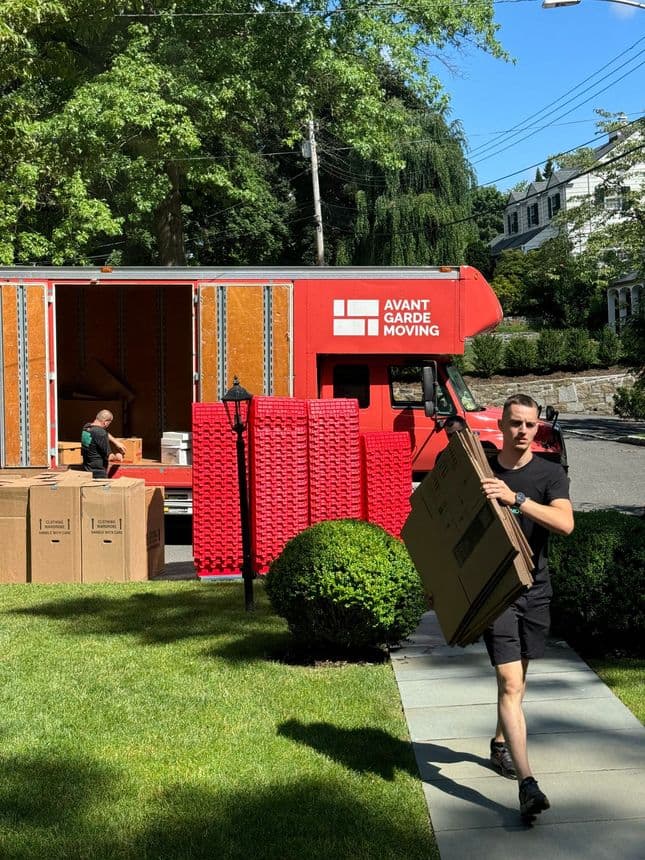
Don't want a closet full of flattened cardboard afterward? Reusable plastic moving bins get dropped off and picked up, stack cleanly, and survive a rainy curb better than cardboard. For a city apartment with limited storage, they're often the easier call.
The Right Packing Order
Pack in the order you'll miss things least. Start weeks out with what you don't touch daily; end with the stuff you use up to the last hour.
The sequence that works:
- Storage, closets, and off-season items (4-6 weeks out)
- Books, décor, art, and rarely-used kitchen gear (3-4 weeks out)
- Most of the kitchen and non-essential clothing (1-2 weeks out)
- An "essentials" box packed last and loaded last (final days)
That essentials box is your sanity. A few changes of clothes, chargers, medications, toiletries, basic tools, toilet paper, snacks, and important documents. Mark it clearly and keep it with you, not buried in the truck.
Kitchen: The Hardest Room, So Plan For It
The kitchen has the most fragile, oddly-shaped, and heavy stuff in the apartment. Budget more time than you think.
Dishes go vertical, not stacked. Wrap each plate in paper, then stand them on edge in a dish-barrel box like records in a crate. Plates resist breaking on their edge far better than flat under weight.
Room-by-room kitchen moves:
- Glasses and stemware: wrap individually, fill the hollows with paper, and use cell dividers if you have them. Heaviest glass on the bottom.
- Pots and pans: nest them with paper between each, lids wrapped separately.
- Knives: wrap the blades in a towel or cardboard sleeve and tape shut. Never pack a loose blade.
- Pantry: pack sealed, non-perishable food in small boxes. Toss or donate anything open, expired, or heavy and cheap to replace.
- Small appliances: original boxes if you kept them; otherwise pad well and tape down loose cords.
Keep kitchen boxes small. A large box full of cookware becomes a box no one can lift up four flights.
Bedroom: Easy Wins, Pack These Early
Bedrooms are mostly soft goods, which makes them forgiving and a great place to build confidence.
- Bedding and pillows go in large boxes or, in a pinch, clean garbage bags clearly labeled (and never mixed in with actual trash).
- Dresser drawers can often stay packed: pull the drawer, stretch-wrap it, and many movers will carry it as-is or reload it. Confirm with your crew first.
- Nightstands and lamps: remove bulbs and shades, wrap shades in their own box, bundle cords.
- Under-bed bins are already half-packed. Tape and label.
Strip the bed last so you sleep in it until the end.
Closet: Don't Fold What's on Hangers
Refolding a whole closet is wasted work. Keep hanging clothes hanging.
Use wardrobe boxes. They have a built-in bar, so you transfer clothes straight from the rod and they arrive ready to re-hang. For a cheaper hack, gather a section of hangers, pull a large trash bag up over the clothes from the bottom, and tie it at the hangers.
Shoes, folded clothes, and bags go in medium boxes. Off-season clothing gets packed first since you won't need it before the move.
Bathroom: Small Room, Big Mess Potential
The bathroom is quick but leaks waiting to happen.
- Open liquids: seal caps with tape, then bag them. Better yet, dump near-empty bottles; you're not paying to move half a shampoo.
- Medications and toiletries you use daily go in the essentials box, not a sealed bathroom box.
- Towels double as padding elsewhere, so wrap fragile items in them and save a box.
- Glass and mirrors: wrap and box, never loose.
Most bathrooms fit in one or two small boxes. Knock it out in an evening.
Living Room: Electronics, Art, and the Awkward Stuff
This room mixes valuable electronics with fragile décor, so slow down.
Photograph the back of your TV and electronics before unplugging so you can rewire in five minutes, not fifty. Bag and label each cable bundle. Use original boxes for electronics when you have them; if not, a TV box with foam corners and a clear "this side up."
For everything else:
- Books in small boxes only, since they get heavy fast.
- Lamps and décor wrapped individually, no stacking pressure on anything fragile.
- Rugs rolled, not folded, and stretch-wrapped.
Fragile Items and Art: Where DIY Hits Its Limit
This is the category that decides whether you should keep packing or call in help.
A framed print can travel in a picture box with corner protection and a glassine layer between glass and paper. That's a reasonable DIY job. But a large painting, an heirloom mirror, original art, a marble top, or anything you'd be sick to lose is a different conversation. These get custom protection, and the gap between a soft-pack and a proper custom crate is exactly where expensive damage happens.
Some things should never go in a standard box at all: flammables, certain liquids, and a surprising list of household items. Read items to never pack in standard moving boxes before you seal anything questionable.
When the fragile pile gets serious, professional packing and unpacking pays for itself in one un-broken heirloom.
Label Like You'll Forget Everything (You Will)
Future-you, exhausted on moving day, will thank present-you for a labeling system.
A label that works has three things:
- Destination room ("KITCHEN," "BEDROOM 2"), so movers drop it in the right place without asking.
- A number and a contents note ("KITCHEN 3: glasses, fragile").
- A color matching that room, on tape or a sticker, visible from across a hallway.
Mark "FRAGILE" and "THIS SIDE UP" on the top and two sides. Boxes get stacked, and the top disappears. Keep a quick list on your phone of what's in each numbered box. When something's missing on day one, you'll find it in seconds.
NYC Reality: Walk-Ups, Elevators, and COIs
How you pack should bend to how your building actually moves.
Walk-ups: Keep boxes small and uniform. A crew can carry a steady stack of 20 manageable boxes down four flights far faster than wrestling a few monsters. Heavy items in small boxes is non-negotiable here. Your back and your movers' will agree.
Elevator buildings: Most co-ops and condos require booking the freight or service elevator and reserving a window, often with padded walls. Pack so your boxes are ready before that window opens, because elevator time is the bottleneck, not the truck.
COIs: Many NYC buildings won't let movers in without a Certificate of Insurance approved by management days in advance. This has nothing to do with packing, but it'll stop your move cold if ignored, so sort it early. Our NYC building rules and COI guide covers exactly what to request.
The cleaner your boxes are staged by the door, the less elevator time you burn and the lower your overall bill.
When to Stop Packing and Call the Pros
DIY packing makes sense when you have time, a manageable amount of stuff, and nothing too precious. It stops making sense fast when any of these are true:
- You're short on time or moving last-minute.
- You have a lot of fragile, high-value, or oddly-shaped items.
- It's a long-distance move where every box gets handled more.
- Packing stress is eating into work, sleep, or sanity.
Full-service packers move quickly, bring the right materials, and carry the liability if something they packed breaks. We break down the real trade-offs in professional packers vs. packing yourself. For many NYC movers, a hybrid works best: you handle clothes and books, pros handle the kitchen and the fragile stuff.
Frequently Asked Questions
How far in advance should I start packing for a NYC move?
Start three to four weeks out for an average one- or two-bedroom apartment, packing a little each day. Begin with storage, closets, and off-season items, and save daily essentials for the final days. Studios can compress to one or two weeks; larger homes or those with lots of fragile items need more lead time.
How many boxes will I need for a NYC apartment?
As a rough guide, expect roughly 10-20 boxes for a studio, 20-40 for a one-bedroom, and 40-60-plus for a two-bedroom. Add more if you own a lot of books, kitchenware, or décor. It's always better to have extras; unused flat boxes are easy to set aside, and reusable bins solve the storage problem entirely.
Should I use plastic bins or cardboard boxes?
Both work. Cardboard is cheap and disposable but takes up space and hates moisture. Reusable plastic bins stack better, protect against rain and crushing, and get picked up after, which is ideal for small apartments with no place to store cardboard. Many movers mix the two.
What should I never pack myself?
Skip DIY on anything irreplaceable or high-value: original art, antiques, heirloom mirrors, marble, and large fragile pieces all deserve professional packing or custom crating. Also never box flammables, corrosives, or certain household chemicals; see items to never pack in standard moving boxes.
How do I pack so moving day goes faster in a walk-up?
Keep every box small and uniform, put heavy items in small boxes, and stage everything by the door before the crew arrives. A steady stream of liftable boxes moves down stairs far faster than a few overloaded ones, and pre-staging means no wasted trips back into the apartment.
Is it worth paying for professional packing?
If you're short on time, have lots of fragile or valuable items, or are moving long-distance, yes. Pros are faster, better-equipped, and liable for what they pack. A common middle ground is packing your own clothes and books while handing the kitchen and fragile items to a packing service.
Bottom Line
Knowing how to pack for a move in NYC comes down to order, supplies, and labeling: finish one room at a time, put heavy things in small boxes, and mark every box by destination room. Respect your building's walk-up, elevator, and COI realities, and the move itself becomes the easy part. When the fragile pile or the clock gets ahead of you, that's the signal to bring in help.
Ready to move? Get your free quote and let Avant-Garde Moving handle the packing, the boxes, and the building logistics, so all you have to do is point at the rooms.