
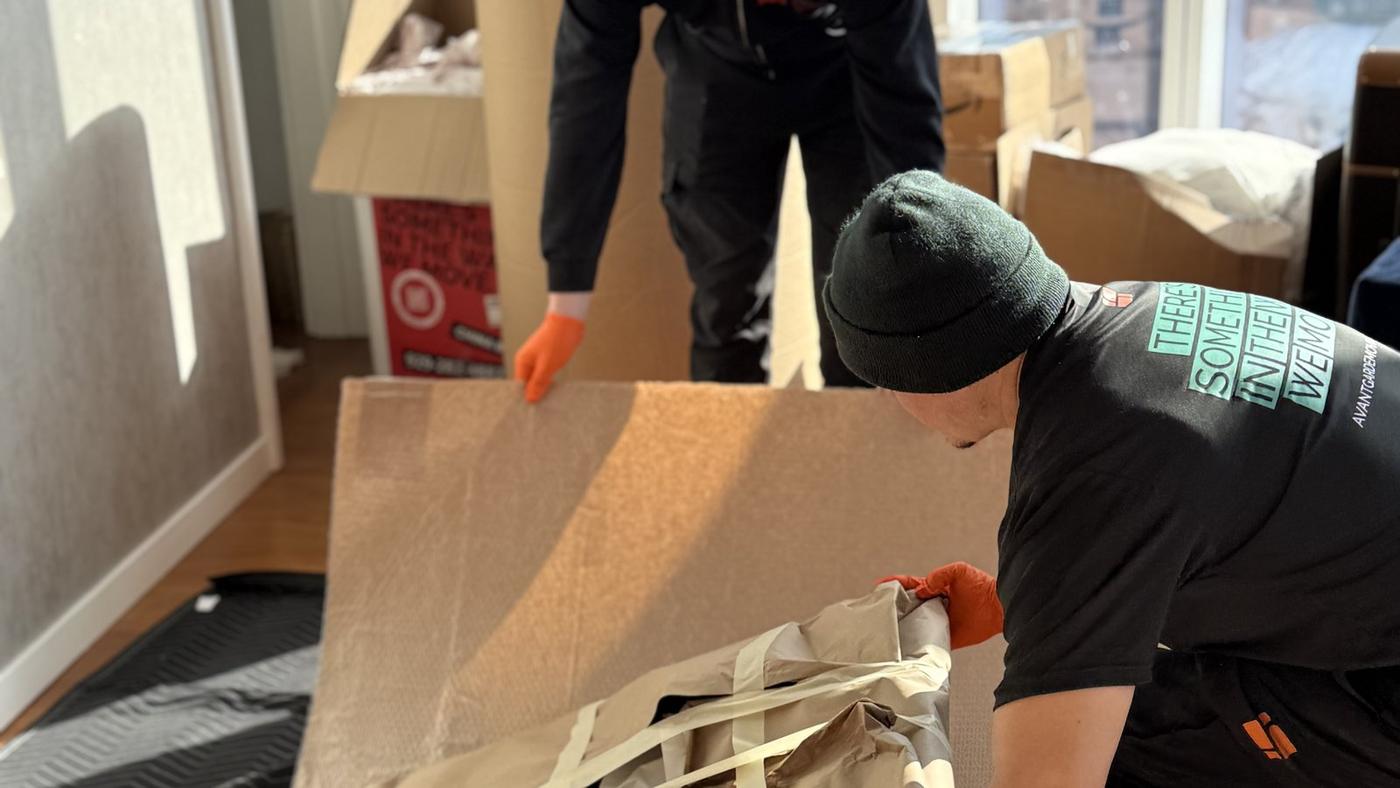

A pool table looks like one piece of furniture. It is really a kit: a wood frame, a stone bed, six rails, six pockets, and a sheet of cloth stretched over the top. The stone is what makes the move hard.
So can a few strong friends lift the table and carry it out? For a slate table, no. It has to come apart, and it has to be leveled again at the other end. This guide covers both, plus what New York City buildings add to the job.
The Short Answer
You cannot safely move a slate pool table without taking it apart. The slate alone weighs hundreds of pounds, and the frame is built to hold that stone flat, not to be carried. The pockets, rails, cloth, and slate come off in that order. At the new home, the frame is leveled, the slate is shimmed and its seams are filled, and the cloth goes back on.
| Table Size | Assembled Weight | Slate Alone (3-Piece Set) | Minimum Room, 58-Inch Cue |
|---|---|---|---|
| 7 ft | 800 lbs | 400 lbs | 13 ft x 16 ft |
| 8 ft | 1,000 lbs | 570 lbs | 13 ft x 17 ft |
| 9 ft | 1,200 lbs | 750 lbs | 14 ft x 18 ft |
Weights are the figures Diamond Billiards publishes for its Pro-Am tables and its three-piece slate sets. Room sizes are from Brunswick's room size guide. Other brands and furniture-style home tables will differ, so treat the table as a reference point, not a spec for yours.
Why a Slate Table Cannot Move in One Piece
The Slate Is Half the Weight or More
On an 8-foot Diamond, the slate is 570 of the 1,000 pounds. Diamond cuts that slate 30 mm thick, which is about 1 3/16 inches.
The World Pool-Billiard Association's equipment specifications call for slate at least 1 inch thick. The Billiard Congress of America's specifications recommend the same 1-inch minimum for tournament-size tables.
Slate is strong when it lies flat and fully supported. It is not forgiving when it is twisted, dropped on a corner, or bumped into a door frame.
One-Piece vs Three-Piece Slate
Most full-size home tables use three slate sections of equal size. Both the WPA and the BCA call for a three-piece set on tournament tables. Split three ways, the Diamond sets above work out to roughly 130 pounds a section on a 7-foot table, 190 on an 8-foot, and 250 on a 9-foot.
That is the point of three-piece slate. Each section can be carried by two or three people and taken up a stairwell on its own.
One-piece slate exists too. The BCA notes that it will sanction play on home and coin-operated tables with one-piece slate. A single slab has no seams to fill, but none of that weight can be shared out. It needs more hands and a clear, straight path.
The Frame Is Not Built to Be Carried
On a typical table, the slate is screwed down to the frame and the rails are bolted to the slate from underneath. Everything is designed to sit level on four legs. Tip that assembly on edge and the weight lands on joints that were never meant to carry it. Legs rack, frames twist, and the slate can crack.
Check the New Room Before You Move Anything
A pool table needs far more room than its footprint. Players need space to draw a cue back on every side.
Brunswick's guide puts it at about 5 feet of clearance around all sides with a standard 58-inch cue. That is where the room sizes in the table above come from. Brunswick also lists smaller minimums for shorter cues. With a 48-inch cue, an 8-foot table needs about 11 ft 2 in by 15 ft.
Measure the new room before you book anything, and check for columns, radiators, and built-ins that eat into the clearance. In New York, this step rules out a lot of rooms.
How a Pool Table Comes Apart, in Order
Each step exposes the fasteners for the next one. The details below follow the installation manual Brunswick publishes for its Black Wolf table, run in reverse. Your table may differ, so take photos at every step and bag and label the hardware.
1. Pockets
The six pockets come off first. On tables with a ball return, the gully pieces under the table come out too.
2. Rails and Aprons
The rails are held to the slate from below. On the Brunswick table in that manual, studs pass down through the slate and are fastened with nuts at 18 points. The nuts come off from underneath, and the rails lift away. On some tables the rails and aprons come off as one large frame, which is a two-person lift. Rails get wrapped right away, because the cushions and the finished wood both mark easily.
3. The Cloth: Stapled or Glued
Most people call it felt. It is really a woven wool cloth. How it comes off depends on how it was put on.
- Stapled or tacked. If the slate has a wood frame under its edges, the cloth is usually stapled or tacked to that wood. The staples are pulled one at a time. Yank the cloth and it tears.
- Glued. If the slate has no wood backing, the cloth is fixed with contact adhesive along the slate edges. It has to be peeled back slowly, and it often does not survive in reusable shape.
4. Slate Seams and Screws
With the cloth off, you can see the seams between the slate sections. They are filled so the surface plays as one slab. Brunswick's manual calls for a hard putty or beeswax in the joints. Any filler over the slate screws is scraped out, and the screws come out. A slipped driver here can chip the stone.
5. Slate Removal
Each section is lifted straight up and carried out on its own. Nothing gets slid across the frame. If the sections are not obviously marked, they get numbered so they go back in the same positions.
6. Frame and Legs
Last, the frame is lifted off the legs or the legs are unbolted. On many tables the frame can travel in one piece. On others it breaks down further.
How Slate Is Carried and Protected
Slate is carried on edge, not flat like a tray. On edge, a section is at its stiffest.
Each section is wrapped in moving blankets, with extra padding on the corners, and set down on padding, never on a bare corner. In the truck, the sections ride upright, strapped to the wall, with padding between them. Nothing is stacked on top.
On stairs, one section moves at a time, with enough carriers that nobody is rushing.
Reassembly, Leveling, and Why the Cloth Often Gets Replaced
The frame goes up first and is leveled with a precision level. On tables with adjustable feet, Brunswick's method is to find the highest corner and bring the other three up to it.
Then the slate goes on. The sections are set in place and screwed down, and each one is leveled with thin wooden wedges driven between the frame and the slate. The goal is a flush fit at both seams. The WPA and BCA both say all slate joints must sit in the same plane within .005 inch after leveling and shimming.
The seams are then filled with beeswax or putty and scraped smooth. The slate is cleaned. The cloth is stretched and stapled or glued, and the rails and pockets go back on.
So why does the cloth often get replaced? It was stretched and trimmed to fit the table the first time, and glued cloth can tear coming off. Since the table is already stripped to the slate, a move is also the easiest moment to put new cloth on. If yours is fairly new and was stapled, it may be able to go back on. Ask before the job, not during it.
Tools for the Job
- A socket set and a drill or driver for the rail nuts and slate screws
- A staple puller for the cloth and a scraper for the seam filler
- A precision level, not just a short carpenter's level
- Wooden shims, plus beeswax or putty for the seams
- A staple gun or contact adhesive for the cloth
- Moving blankets, straps, and labeled bags for hardware
What Makes NYC Harder
The work on the table is the same anywhere. The path in and out is what changes in New York.
- Walk-ups and brownstone stairs. Every slate section goes up or down by hand, one flight at a time. Tight turns at the landings slow everything down.
- Basements and townhouse game rooms. Many tables here live below grade or on a top floor, at the end of the narrowest stairs in the house.
- Elevators. Most managed buildings want moves in the service elevator, booked ahead for a set window. Long rails and the frame have to fit the cab. Our guide to reserving an elevator for a move covers how the booking works.
- Certificates of insurance. Co-ops, condos, and managed rentals usually will not let a crew in without a COI on file. See our COI guide for how to get one fast.
- Parking. Slate should travel the shortest distance possible between the door and the truck.
Check the rules at the building you are moving into as well as the one you are leaving.
DIY vs Hiring Movers
You can move a pool table yourself. People do. But be clear about where it goes wrong.
- Cracked slate. A dropped or twisted section is usually the end of that section.
- Torn cloth. Pulling cloth off instead of pulling staples out ruins it.
- Injuries. A 190-pound slab of stone on a staircase is a real hazard to backs, hands, and feet.
- A table that does not play right. Getting three slate sections flush at the seams takes the right level, the right shims, and patience.
DIY makes the most sense for a lighter table and a ground-floor move. If there are stairs, a one-piece slate, or a table you care about, hire it out.
What Drives the Cost
We are not going to give you a number here, because a fair one depends on your table and your buildings. The price moves with table size, one-piece or three-piece slate, stairs at either end, the distance between addresses, new cloth, and any storage in between.
For context only, standard local moves in NYC run about $150 to $200 per hour in summer and $100 to $140 per hour in winter, as covered in our guide to the best time to move in NYC. A pool table is specialty work, so ask for a written quote for your table. Our guide to moving insurance in NYC explains how it is covered if something breaks.
Storing a Pool Table
A pool table is stored the way it is moved: in pieces. Slate sections are wrapped and kept on edge, with nothing leaning on them. Rails are wrapped so the cushions are not pressed or bent. Hardware is bagged, labeled, and kept with the frame.
If your new place is not ready, the table can go into storage between the two halves of the job and be reassembled when you have the room.
Coin-Op, Bar, and Antique Tables
Coin-op and bar tables. Brunswick calls the 7-foot size "bar-size," and coin-operated tables are often built with one-piece slate. The slab cannot be split, so the path out matters more than usual. Measure doors and stairs before the day.
Antique tables. Older tables are not always built like modern ones, and replacement parts can be hard to find. Do not assume modern hardware. Photograph everything, label every piece, and go slowly. The finish needs the same care as any old wood piece, which we cover in our guide to moving antique furniture in NYC.
If you also own a piano, our guide to moving a piano in NYC covers the other heavy thing in the room.
Frequently Asked Questions
Can you move a pool table without taking it apart?
Not a slate table, and not safely. The slate is half the weight or more, and the frame is built to hold it flat on four legs. Carrying the assembled table risks cracking the slate and twisting the frame.
How much does a pool table weigh?
It depends on the size and the maker. Diamond lists its Pro-Am tables at 800 pounds for a 7-foot, 1,000 pounds for an 8-foot, and 1,200 pounds for a 9-foot. About half or more of that is slate.
How long does it take to move a pool table?
As a rough guide, disassembly takes one to two hours and reassembly with leveling takes two to three, plus travel time. Stairs at either end add to that.
Do I have to replace the felt when I move a pool table?
Not always. Stapled cloth in good shape can often go back on. Glued cloth, or cloth that is already worn, usually gets replaced.
How much room do I need for a pool table?
With a standard 58-inch cue, Brunswick's guide lists minimum rooms of 13 by 16 feet for a 7-foot table, 13 by 17 feet for an 8-foot, and 14 by 18 feet for a 9-foot. Shorter cues reduce the room needed.
Can a pool table go up a walk-up or into a basement?
Usually, yes, because it travels in pieces. One-piece slate is much harder on stairs and may not be possible in a tight stairwell. Send photos and measurements of the stairs before you book.
The Bottom Line
A pool table move is three jobs: take it apart in the right order, carry several hundred pounds of stone without cracking it, and rebuild it level.
Before anything else, measure the new room and the path to it. Find out if your slate is one piece or three. Book the elevator and start the COI early. Then decide honestly whether your table and your stairs make this a DIY job.
Have a pool table that needs to get across the city, or just across the room? Avant-Garde Moving handles disassembly, transport, reassembly, and leveling as part of our pool table moving service across New York City. Tell us the table size and what the stairs look like when you request your free quote.

