

Dishes almost never break because a mover dropped a box. They break because the box was packed so that a normal bump was enough. Plates stacked flat. Glasses rolling loose in the corners. A bottom held shut with one strip of tape. A box so heavy that nobody could carry it level.
The kitchen is the room we pack most carefully on every job. It is also the room most people leave for last and pack at midnight.
This guide is the method our packers use. By the end you will know which boxes and paper to buy, how to build a box that will not open, how to pack every kind of dish from dinner plates to wine glasses, and how to tell a box is ready before you tape it shut.
The Short Answer
Wrap every piece on its own in clean, unprinted packing paper. Put 2 to 3 inches of crumpled paper in the bottom of a double-wall dish box. Stand plates on edge, like records, never flat. Heaviest pieces go on the bottom, glasses and stemware on top, with a layer of crumpled paper between each layer. Fill every gap, keep the box light enough to carry comfortably, and do a shake test before you seal it. If nothing moves, it is ready.
What You Need
Buy everything before you start. Running out of paper halfway through a box is how people end up wrapping a gravy boat in a sock.
| Material | What to Get | Why It Matters |
|---|---|---|
| Dish pack box (dish barrel) | Double-wall corrugated box. U-Haul's Dish Barrel box is 18 x 18 x 28 inches. | Two layers of cardboard in the walls resist crushing when other boxes are stacked on top. |
| Smaller double-wall boxes | Small or medium size | For heavy stacks of plates, fine china, and walk-ups where a full dish barrel gets too heavy. |
| Cell dividers | Cardboard inserts that fit your box | Give each glass its own pocket so glass never touches glass. |
| Packing paper | Plain, unprinted newsprint. Buy more than you think. | Clean, soft, and it crumples into cushion. Newspaper ink rubs off onto dishes and your hands. |
| Bubble wrap | One roll is usually plenty | A second layer for stemware, fine china, and heirlooms. Not needed for everyday plates. |
| Packing tape | 2-inch packing tape and a tape gun | Cheap tape lets go. A tape gun makes the box bottom go fast. |
| Thick marker | Black permanent marker | For labels on the top and every side. |
A note on bubble wrap. For most dishes, paper does the job better. It fills odd shapes and takes up less room. Save bubble wrap for the pieces that really need it.
Build the Box First
A dish box that opens from the bottom is the worst thing that can happen in a kitchen move. Build every box the same way:
- Tape the center seam where the bottom flaps meet. Run two or three strips along it.
- Tape across the seam in the other direction, so the tape makes a plus sign.
- Tape the two edge seams where the flaps meet the sides of the box. This is the step most people skip, and it is the one that keeps the corners from splitting.
- Add a cushion layer. Put 2 to 3 inches of loosely crumpled paper in the bottom. Never set a dish on bare cardboard.
The Core Rule: Plates Go In on Edge
If you remember one thing from this guide, make it this one. Plates travel standing on their edge, not lying flat.
A plate is strongest around its rim. When plates are stacked flat, every bump on the stairs or the truck pushes the weight of the whole stack down into the thin center of the plate at the bottom. That is where cracks start. Standing on edge, the force runs along the rim of each plate, and the plates support each other side by side.
How to Pack Plates
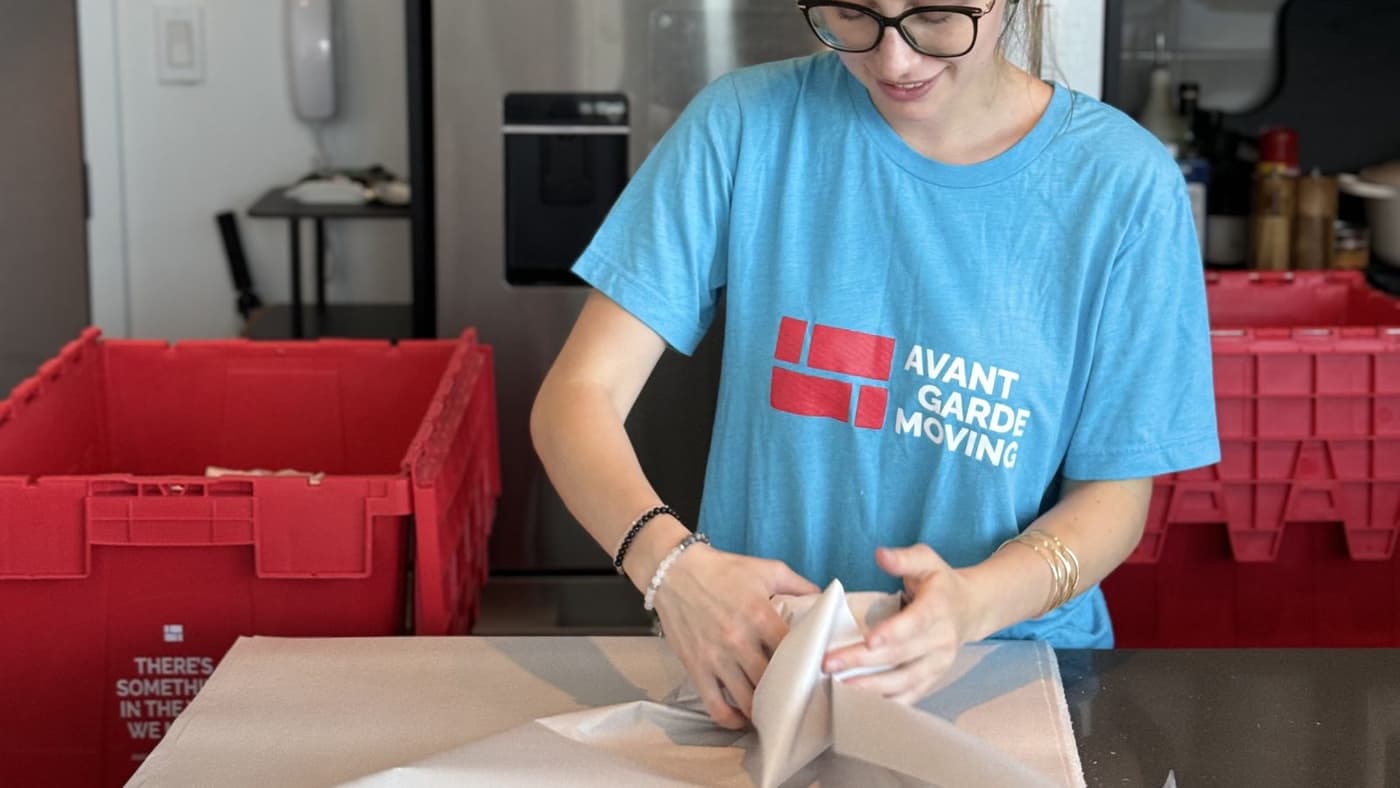
- Set up a wrapping station. Lay a stack of packing paper on a clear counter.
- Wrap each plate. Set it in the center of the paper and fold two sheets over it, corner by corner, until it is covered.
- Bundle them. Stack three or four wrapped plates of the same size and wrap the stack in two more sheets.
- Stand bundles on edge on the cushion layer, packed tight side by side like records in a crate. Stuff paper into any gap along the walls.
- Cap the layer with 2 or 3 inches of crumpled paper before the next layer.
Dinner plates and heavy stoneware go on the bottom. Salad plates and saucers go in the next layer up.
How to Pack Bowls
Bowls can nest, but never bare bowl against bare bowl.
- Wrap each bowl, pushing a corner of paper down into it so the inside is covered.
- Nest two or three wrapped bowls of the same size with crumpled paper between them, then wrap the stack as one bundle.
- Stand bundles on their side, or rim down, in the middle layer of the box.
Large serving and mixing bowls get wrapped on their own, with an extra layer of paper or bubble wrap, and packed in the center of a layer.
How to Pack Cups and Mugs
The handle is the weak point. It sticks out, it catches, and it snaps.
- Stuff a ball of paper inside the cup.
- Wrap a strip of folded paper around the handle first.
- Then wrap the whole cup, tucking the ends in tightly.
- Pack mugs in an upper layer, close together, or in cell dividers so the handles cannot knock into each other.
How to Pack Glasses and Stemware
Glass is the lightest and most fragile thing in the kitchen, so it always goes in the top layer, with nothing but paper above it.
Everyday glasses and tumblers:
- Stuff paper inside each glass.
- Wrap the outside in one or two sheets, rolling the glass across the paper and tucking in both ends.
- Stand it upright in a cell divider, one glass per pocket.
No dividers? Wrap each glass a little thicker and pack them upright in a single layer, close together, with paper packed between them.
Wine glasses and stemware:
- Stuff the bowl of the glass gently with crumpled paper. It keeps the thin glass from flexing.
- Wrap the stem with a folded strip of paper or a small piece of bubble wrap. The stem is where most wine glasses break.
- Wrap the whole glass in paper, then add a layer of bubble wrap for good crystal.
- Stand it upright in its own cell in the top layer of the box.
How to Pack Fine China and Heirlooms
- Double wrap. Paper against the china, then bubble wrap on the outside.
- Use smaller boxes. A small, full box is stronger and easier to carry level than a large one.
- Double box the best pieces. Set the small box inside a bigger one with at least 2 inches of crumpled paper on every side. The outer box takes the bumps.
- Wrap teacups and saucers one by one, then bundle each cup with its saucer.
For a piece that truly cannot be replaced, like a great-grandmother's tureen or a valuable porcelain set, a box may not be enough. A custom-built crate holds the piece so it cannot shift. Our guide to items you should never pack in standard moving boxes covers when a crate is the right call.
Platters, Serving Pieces, and Odd Shapes
- Platters and large serving plates go on edge, like plates, along the walls of the box. Wrap each one on its own with extra paper on the rim.
- Gravy boats, butter dishes, and teapots get wrapped in two parts, with the lid packed right next to its base.
- Pitchers and vases get paper inside, extra paper around the spout or handle, then a full wrap.
Pots, Pans, and Small Appliances
These are heavy, not fragile. Keep them out of your dish boxes.
- Pots and pans nest with a sheet of paper between each one. Wrap glass lids separately and pack them on edge.
- Small appliances go in their original box if you have it. Remove glass carafes and blades and wrap them separately. Tape the cord to the appliance.
- Knives get bundled in paper or a towel, taped, and marked "KNIVES" so nobody grabs the blade end.
Fill Every Gap, Then Close It Up
Empty space is what breaks dishes. Any gap lets a piece shift, and a piece that shifts hits the one next to it.
Fill the gaps with crumpled paper. Dish towels and cloth napkins work too, and they are coming with you anyway. Finish with 2 to 3 inches of crumpled paper on top, so the flaps press on paper, not on dishes.
The Shake Test
Close the flaps without taping them. Hold the box and give it a gentle shake from side to side.
- You hear clinking or feel something slide: open it up and add more paper.
- It feels solid, like one heavy block: tape it shut.
It takes ten seconds.
How Heavy Should a Dish Box Be?
Dishes are dense. A dish barrel packed to the top with stoneware gets heavy fast. Here is our working rule: if you cannot lift it to waist height and carry it across the room without straining, it is too heavy. In practice, we try to keep dish boxes under about 40 pounds. A box that is hard to carry is a box that gets set down hard, carried tilted, or dropped.
If a box is getting heavy, finish the top with light pieces like glasses, or switch to a smaller box.
Quick Reference by Item
| Item | How to Wrap | Where It Goes | Watch Out For |
|---|---|---|---|
| Dinner plates | 1-2 sheets each, bundles of 3-4 | Bottom layer, on edge | Never stacked flat |
| Salad plates and saucers | 1-2 sheets each, small bundles | Second layer, on edge | Gaps along the box walls |
| Bowls | Paper inside and out, nest 2-3 with paper between | Middle layer, on side or rim down | Bare bowl touching bare bowl |
| Cups and mugs | Paper inside, extra paper on handle | Upper layer or cell dividers | Handles snapping |
| Glasses | Paper inside, 1-2 sheets outside | Top layer, upright in cells | Anything packed on top |
| Stemware | Stuff the bowl, wrap the stem, then full wrap plus bubble | Top layer, own cell | The stem |
| Fine china | Paper, then bubble wrap | Small box, double boxed | Gilded edges, loose lids |
| Platters | Extra paper on the rim | On edge along the box walls | Rims chipping |
| Pots and pans | Paper between nested pieces | Their own box, not a dish box | Weight |
Label Every Dish Box
A good label tells everyone who touches the box how to treat it.
- "FRAGILE" on the top and on all four sides. Boxes get stacked, and the top is often hidden.
- Arrows and "THIS SIDE UP" on the sides. Plates on edge stay safe only if the box stays upright.
- The room and contents: "KITCHEN 4: plates, bowls." You will know exactly which box has the coffee mugs on the first morning.
Why This Matters More in New York
In a suburban move, a dish box goes from the kitchen to the truck on a hand truck and back off again. In New York, the same box might go down four flights of a walk-up by hand, along a block to wherever the truck could park, into a freight elevator with other boxes, and up again at the other end.
Every one of those steps is a chance for the box to tilt, get set down, or get bumped. That is why the standards above are not fussy. On-edge plates, full boxes, and sensible weight are what get your dishes through a long city carry. It is also why we tell people in walk-ups to use more small boxes and fewer huge ones. Our room-by-room packing guide for NYC apartments covers the rest of the apartment the same way.
How Many Dish Boxes Will You Need?
Every kitchen is different, so any single number is a guess. Here is a better way to estimate:
- Pack one test box with your everyday dinner plates and bowls.
- Look at what is left. Count your remaining stacks of plates and bowls, then compare them to what fit in the test box.
- Add separate boxes for glasses, mugs, serving pieces, and anything fragile in the cabinets above the fridge.
- Add two or three spares. Every kitchen has a cabinet nobody remembered.
Pots, pans, pantry items, and small appliances go in regular boxes, so count those separately.
Reusable Plastic Bins: An Alternative to Cardboard
You can skip the boxes and the tape. Our plastic moving bin rentals come pre-assembled and stackable, and we deliver them and pick them up after you unpack, for free.
Rigid plastic walls do not get soft or crush the way cardboard can. But the packing rules do not change. Wrap every piece, stand plates on edge, cushion the bottom, and fill every gap. A bin will protect dishes from the outside, but not from each other.
Should You Pack the Kitchen Yourself?
You can, with the method above. Just budget more time than you think, because every item gets wrapped on its own.
It also helps to know how damage claims work. Interstate movers even have a term for boxes you packed yourself: PBO, "packed by owner". Before you choose, ask your mover how they handle claims on boxes you packed, and read our guide to moving insurance.
Many people pack their own clothes and books and hand just the kitchen to a pro. We compare the options in professional packers vs. packing yourself, and if you live in a small place, see what packing services for a studio apartment include.
Unpacking: Do It in Order
- Unpack the kitchen first, or at least the box marked with your everyday dishes.
- Open dish boxes on a table or counter, not on the floor, and take out one bundle at a time.
- Check the paper before you throw it out. Small saucers, lids, and spoons hide in the crumple.
- Look over each piece as you unwrap it. If something is damaged, photograph it and the box right away, and report it to your mover promptly.
- Recycle the right way. In New York City, packing paper goes in mixed paper recycling, and cardboard boxes must be flattened and tied with twine. Bubble wrap and packing peanuts are not recyclable at the curb, so the city says they go in the trash.
Frequently Asked Questions
What is the best way to pack dishes for moving?
Wrap each piece in clean packing paper, cushion the bottom of a double-wall dish box with 2 to 3 inches of crumpled paper, and stand plates on edge. Put heavy pieces on the bottom and glasses on top, with paper between layers. Fill every gap and shake-test the box before you seal it.
Should plates be packed vertically or flat?
Vertically, on their edge, like records. A plate is strongest around its rim. Stacked flat, every bump pushes the weight of the stack into the center of the bottom plate, which is where cracks start.
Can I use newspaper to pack dishes?
You can, but we do not recommend it. Newspaper ink rubs off onto dishes and your hands, so you end up washing everything. Plain, unprinted packing paper is cleaner and cheap.
What is a dish pack box?
A dish pack, also called a dish barrel, is a tall box made with two layers of corrugated cardboard in the walls. The double wall resists crushing when other boxes are stacked on it. A common size is 18 x 18 x 28 inches.
How do you pack glasses without dividers?
Stuff each glass with paper, wrap the outside in one or two sheets, and stand the glasses upright in a single layer with crumpled paper packed between them. Always put glasses in the top layer, with nothing heavy above them.
How heavy should a box of dishes be?
Light enough to lift to waist height and carry across the room without straining. We try to keep dish boxes under about 40 pounds. A heavy box is more likely to be carried tilted or set down hard.
How do you pack fine china for moving?
Wrap each piece in paper, then bubble wrap, and pack it in a small box. For the best pieces, set that box inside a larger box with at least 2 inches of cushion on every side. For irreplaceable heirlooms, consider a custom crate.
The Bottom Line
Packing dishes well comes down to a few rules: clean paper, a well-taped double-wall box, plates on edge, heavy on the bottom and glass on top, no empty space, and a box you can actually carry. Do the shake test on every box.
In New York, your boxes get handled more than they would almost anywhere else. Pack for the stairs, the long carry, and the crowded freight elevator, and your dishes will come out the way they went in.
Rather not spend three nights wrapping plates? Avant-Garde Moving's packing and unpacking service brings the boxes, paper, and dividers, and packs your kitchen the way this guide describes. Request your free quote and tell us what is in your cabinets.